August 22, 2026
Australia and the Curse of Changing Eras
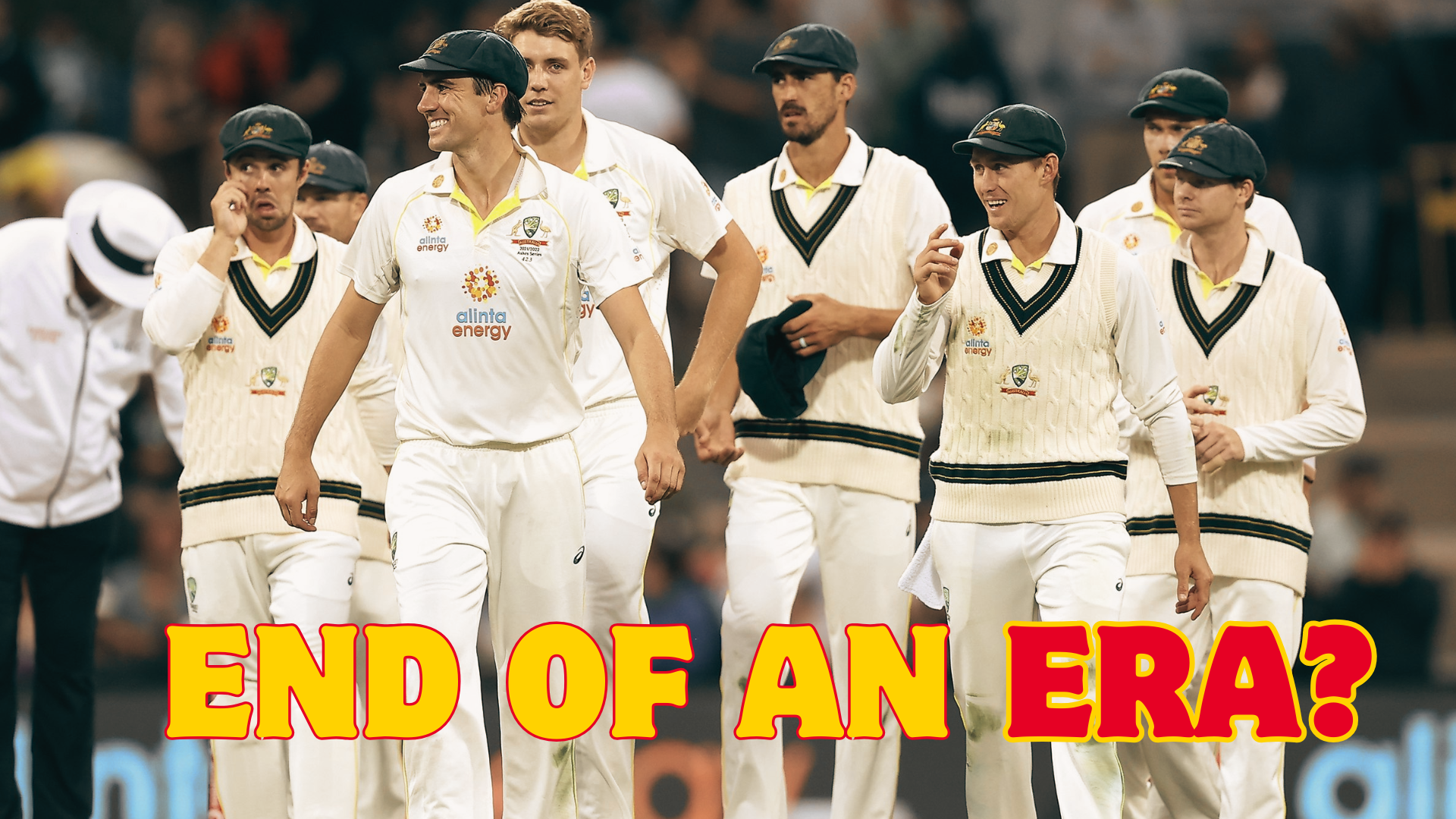
Australia have ruled world cricket through wave after wave of golden generations - and collapsed just as hard each time the guard changed. With a test XI having an average age of 33, and defeats piling up at home, history's grim pattern looks ready to repeat. Is Australia's next fall already underway?
Introduction
In Australian cricket, winning isn’t an achievement. It’s more an absence of crisis. Victory is expected, dominance doesn’t surprise, and a loss is criminal. Australia have by far the most test wins in history, the longest test match win streak in history of 16 straight test wins, achieved twice, and have conquered every corner of the cricketing world. So when the underdogs from Bangladesh travel to Australia for the first time in over two decades for a red-ball tour, get bundled out for just 54 runs in a warm-up game against a C-string Australian side, and are up against Starc, Hazlewood, Cummins, and Lyon, at home, you’d expect them to get steamrolled.
But it was Bangladesh who outplayed Australia in every facet, crushing the hosts by 9 wickets. Nothing can be taken away from Bangladesh. They pressed the advantage in each of the 11 sessions, and secured their first ever win on Australian soil in test cricket history.
The vultures have re-emerged over the Australian test side, as they seem to do after any defeat at home. Except not with such ferocity in a long time. Since 2024, what seemed to be a champion Australian side has lost at The Gabba to an inexperienced West Indies side, lost by the biggest ever margin at the Perth Optus Stadium and their second worst ever loss to India at home, and have allowed a touring Bangladesh team, on just their second ever tour Down Under, to crush them on home turf.
The average age of Australia’s playing XI in their last test was 33.4. Mitchell Starc is 36, Josh Hazlewood is 35, Pat Cummins is 33, and Nathan Lyon is 38. Their youngest player was Cameron Green, who’s 27 and already has 38 tests under his belt. Their most inexperienced player, Jake Weatherald, has played just 6 tests, debuting in last year’s Ashes at 31, and has already been axed ahead of the second test vs. Bangladesh. His replacement: the 30-year old Matt Renshaw, who played 14 tests between 2016 and 2023.

Age: A Scapegoat?
Is age really the issue? New Zealand’s original playing XI in the third test vs England had an average age of 31.5, not far from Australia. Still, they managed an away series win in England, making a comeback after being 1-0 down in the series. This is the same team who also whitewashed India in India during the previous World Test Championship cycle.
This very Australian team themselves have shown that age doesn’t equate to quality. They came back to win the Border Gavaskar Trophy 3-1 after an embarrassing loss in the first test, registered a 2-0 series sweep in Sri Lanka for the first time since 2003, whitewashed the West Indies at home, and won a home Ashes within the first three tests last summer.
So why exactly are Australia under so much scrutiny with regards to the age of their players?
Many teams have had eras of unmatched dominance. The West Indies of the 70s and 80s, South Africa in the late 2000s to early 2010s. Only Australia, though, has been able to have multiple eras at the undisputable top. Yet after each of Australia’s periods of success seems to come an inevitable fall, almost off a cliff. The Australia test side loves their peaks, but can’t seem to avoid what comes after.
Shifts in Eras
Look at Australia’s rolling 25-test W/L ratio.
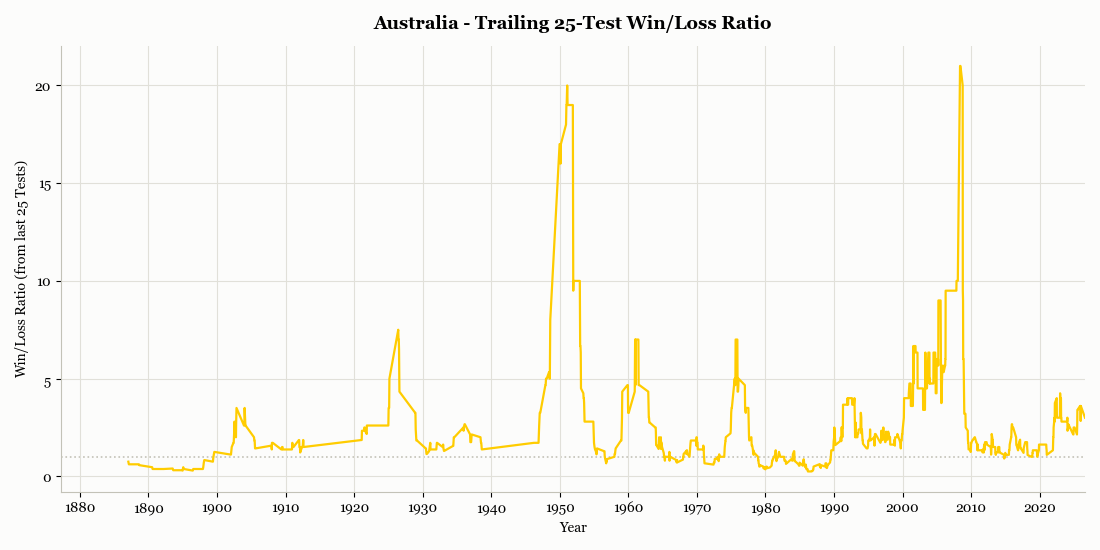
Australia unsurprisingly dominated the post-war era, peaking with a W/L ratio of nearly 20 in 1951. For much of this era, they had Don Bradman, Keith Miller, Ray Lindwall, Lindsay Hassett, stretching to Neil Harvey and Arthur Morris later on. But the bulk of these players retired in the mid 1950s, coinciding with Australia’s rolling win-loss ratio dropping below par in the 1950s. But Australia didn’t take long to recover, with Richie Benaud, Bob Simpson, and Bill Lawry in the 1960s. Even without direct replacements to the 50s, Australia found players to step up in different roles and maintained their status as a formidable test side.
The 1970s-80s
The first real transition issue came in the early 1980s. In 1984, Greg Chappell, Dennis Lillee, and Rod Marsh, retired after the same test against Pakistan. Australia lost their best bowler, batter, and keeper all in one swoop. Jeff Thomson’s retirement followed just a year later. After peaking with a rolling win-loss at close to 7 in 1976, Australia saw their lowest ever period in test history from 1979 to 1989, nearly an entire decade where they were below par on win-loss.
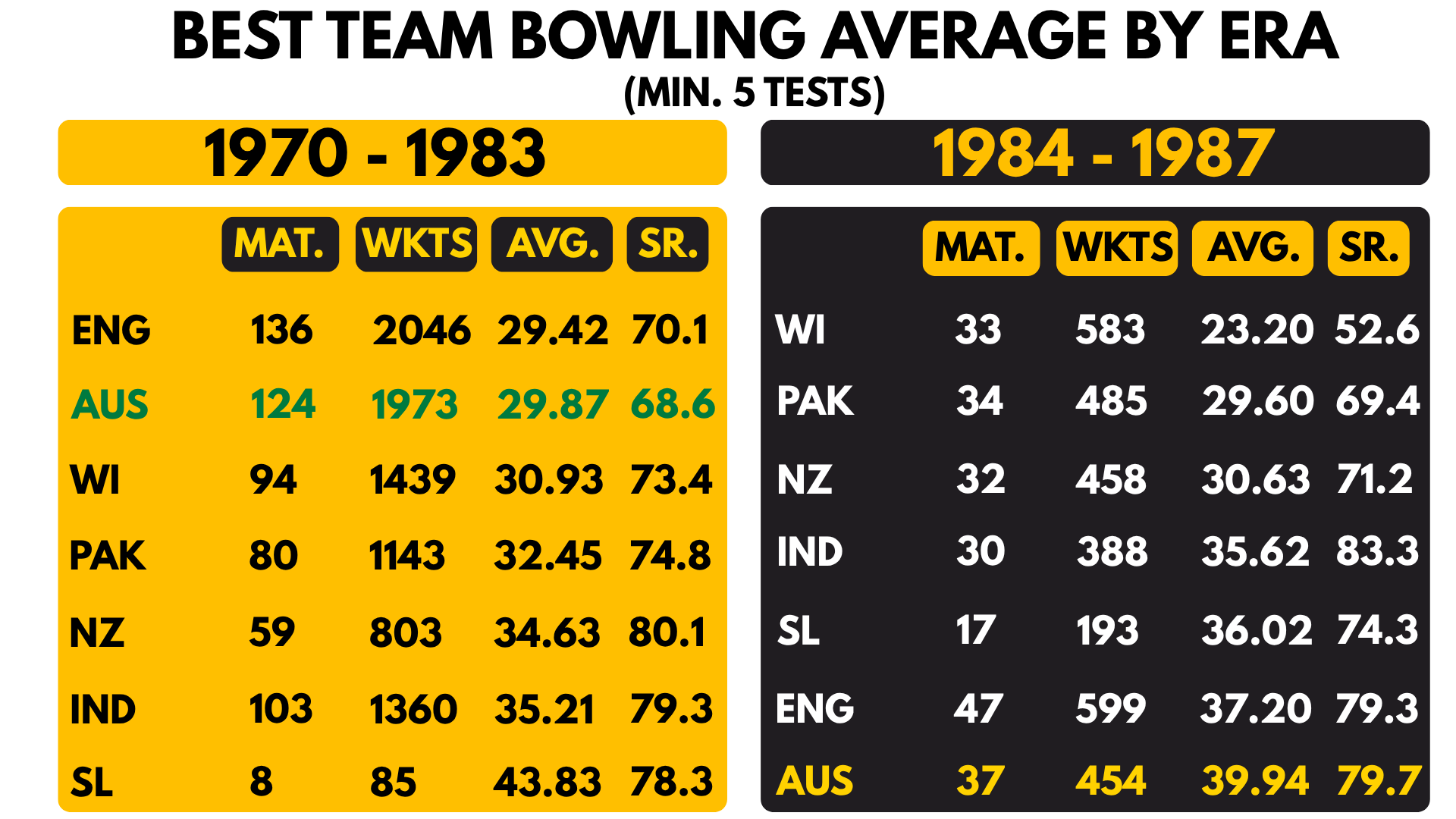
From being the second-best bowling side in the 70s, with the second-lowest bowling average and lowest bowling strike rate, Australia flopped to the bottom from 1984-1987. Once Lillee and Thomson retired, Australia struggled, averaging 39.94 - ten runs more per wicket than the previous decade - while taking over 11 more balls per wicket than before. Not only did Australia see a decline, but their competitors were far stronger now. The West Indies were on another planet, averaging just 23.2 and taking a wicket every 52 balls from 1984-1987.
By the late 80s, Australia were able to rebuild around Dean Jones, Merv Hughes, David Boon, Steve Waugh, Mark Taylor, and of course, the great leader Allan Border. They went on to win their first World Cup in 1987. Even as they established a new era of dominance, though, they didn’t forget the lows of the previous decade.
Interestingly, it seemed as though this drought taught Australia how to properly manage transitions. From Allan Border to Mark Taylor to Steve Waugh to Ricky Ponting, Australia found four successive captains who led Australia to the top of world cricket for nearly 20 straight years. Their lowest period from 1990 to 2009 was when Mark Taylor took over from Allan Border, and even then, they managed a solid win-loss ratio well over 2.
The 2000s-2010s
The early 2000s brought about what is widely regarded as Australia’s Golden Generation, under Steve Waugh and then Ricky Ponting. In this period, they went on a 16-match win streak from 1999-2001 under Waugh, then tied their own 16-win record again from 2006-2008 under Ponting. They were absolutely unbeatable everywhere in the world, with their rolling win-loss ratio never dropping below 3.0 in this period. However, much like the 70s, reaching such unimaginable heights meant that when the team’s spine was pulled at once, Australia saw new lows.
Shane Warne, Glenn McGrath, and Justin Langer all retired together in 2007 after cementing a home Ashes whitewash. Damien Martyn had also just quit earlier that series. Australia once again lost several key players: their greatest ever spinner, their best quick, and two long-term reliable top and middle-order batters. Gillespie had already played his last test a year earlier, and within the next 18 months, Adam Gilchrist, Brett Lee, and Matthew Hayden all stepped away from test cricket.
Captain Ricky Ponting was tasked with rebuilding the side, practically from scratch, having lost nearly every piece to Australia’s puzzle in a short span. Australia saw another low period in their test history in the early 2010s, arguably more harsh on the players given the heights their team had achieved just a few years ago. Despite notable fresh talent coming of age, like Michael Clarke, Australia struggled with the transition.
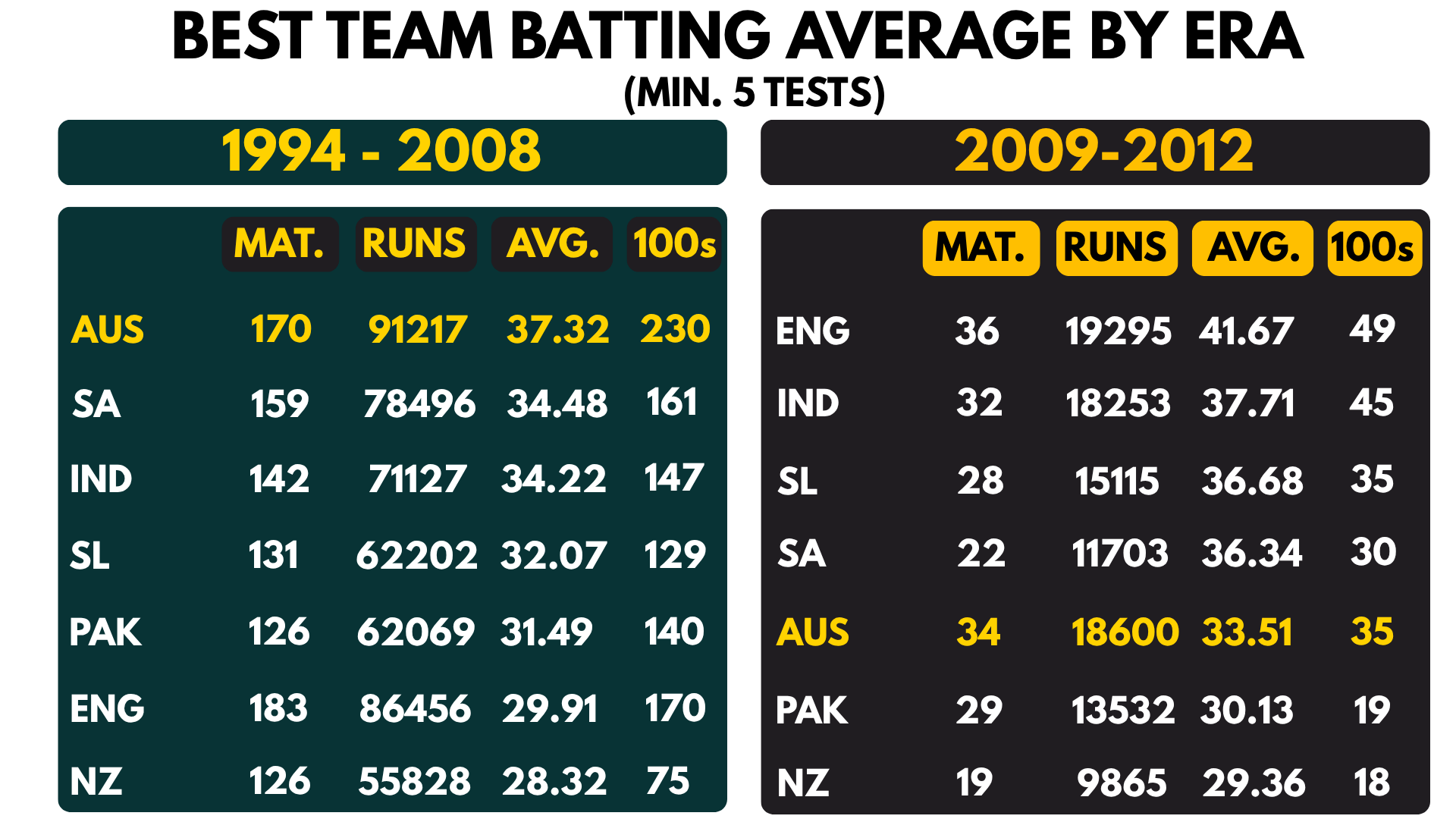
This time, it was the batting that significantly declined. From 1994-2008, Australia's Golden Era, the Aussies were by far the best batting side. Having played the second-most test, they unsurprisingly stacked the most runs (91217) and most centuries (230) in this time. But they also averaged the most per wicket, at 37.32. South Africa had the next best runs per wicket, at 34.48.
From 2009 to 2011, Australia's batting had fallen off, with runs per wicket dropping to 33.51, the fifth best among teams with at least 5 tests in this time. They also had just 35 hundreds in this time, 14 less than England, who played only two more tests than Australia in this time.
They lost a home Ashes series in 2010/11, their first home loss since the summer of 1986. They went on to lose three consecutive Ashes from 2009 to 2013. Since 1897, England has only won three consecutive Ashes three times: in the mid 1950s, the late 1970s to early 1980s, and 2009-2011-2013. All three of these periods were times of significant transition for Australia, where they lost the bulk of their team in quick succession, and were in a prolonged period of rebuilding.
A Turbulent 2010s
It took Australia until 2013/2014, when they whitewashed England at home again, to look as formidable as they once did. It seemed like the mid 2010s would begin another golden age for Australia: Mitch Johnson was breathing fire, young Mitchell Starc and Pat Cummins had already made their mark in test cricket, Nathan Lyon looked to be a promising long-term prospect, and by 2014, Australia had a decent batting core with Steve Smith and David Warner around Michael Clarke.
However, things didn’t quite pan out as Australia would have hoped. Clarke’s sudden retirement in the 2015 Ashes was a shock, and with the 2018 sandpaper-gate incident that kept Smith, Warner and Bancroft out of test cricket for a year, crisis hit Australia. Given the circumstances, Tim Paine managed a reasonable record as captain in a tough time for Australian cricket. Paine was also at the center of controversy, though, and was sacked ahead of the 2021 home Ashes series. Australia seemed to face curveball after curveball in what otherwise seemed to be a promising era with a talented pool of players.
Cummins to the Rescue
That is when Pat Cummins stepped up as captain. Cummins sealed a convincing 4-0 home Ashes win, and finally seemed to set Australia back on track. They now had a settled side, with Marnus Labuschagne and Travis Head having cemented their places in the side, and Usman Khawaja making a remarkable comeback. With a bowling attack to envy, and a batting lineup that finally seemed balanced, Australia found another phase of dominance.
The Aussies secured their first series win in Asia since 2011, in a 1-0 win against Pakistan. After a successful home summer against the West Indies and South Africa, they bagged their first World Test Championship title in 2023, and went on to secure the ODI World Cup in India, too. The following summer, they finally won the Border-Gavaskar Trophy after a decade, swept Sri Lanka in Sri Lanka 2-0, whitewashed the West Indies in the Caribbean, and won a home Ashes 4-1.
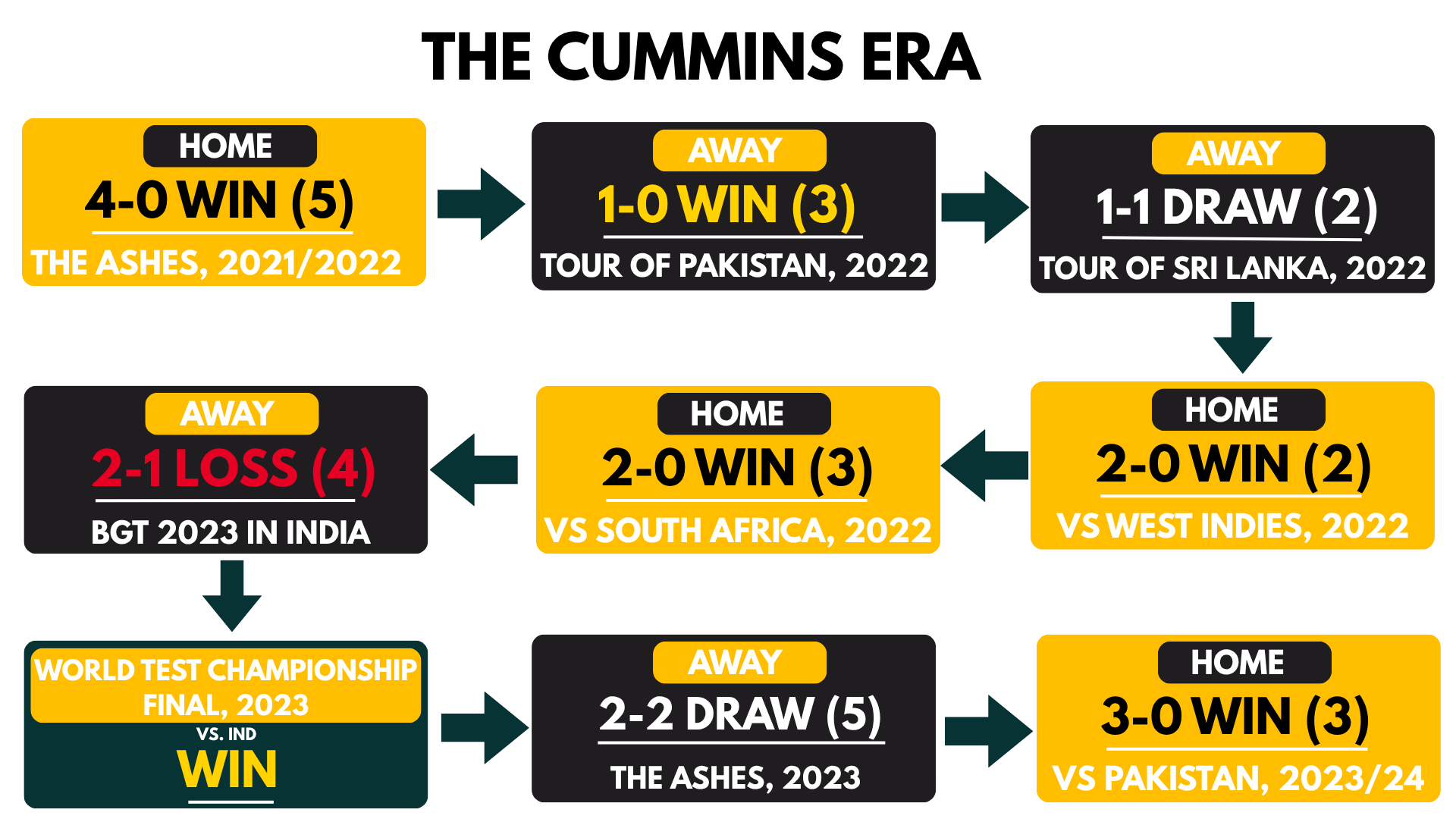
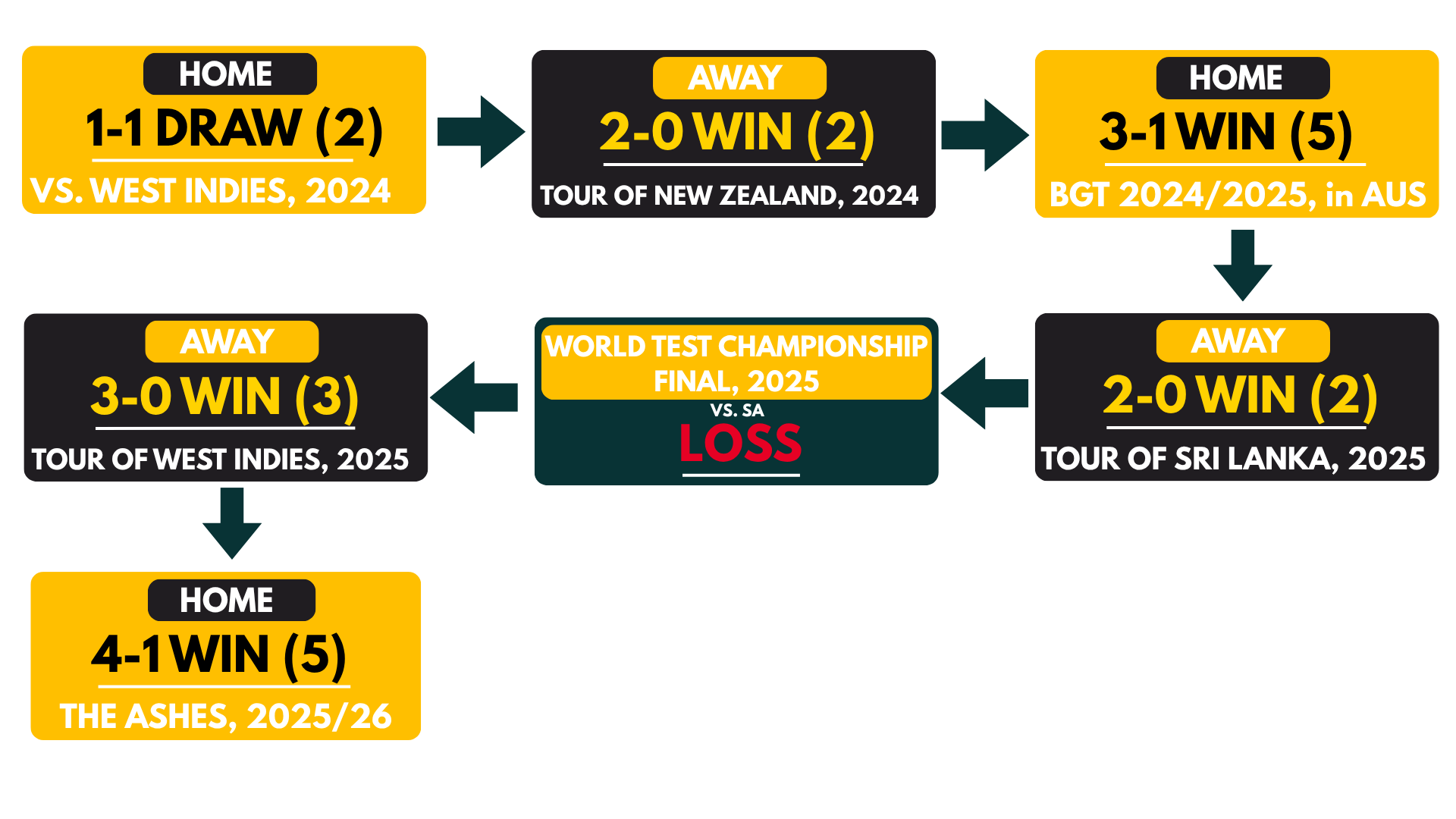
The Cummins era has been a restoration of dominance for Australia; their rolling win-loss has stayed well above 2.0, peaking at nearly 4.0 in 2022.
Impending Changes
So why all the noise now? Despite resounding victories on paper, the current Australian side have more than shown a few cracks in their armor. Many of their batters have struggled with consistency, and the bowling cartel that has served Australia for over a decade has been prone to injuries.
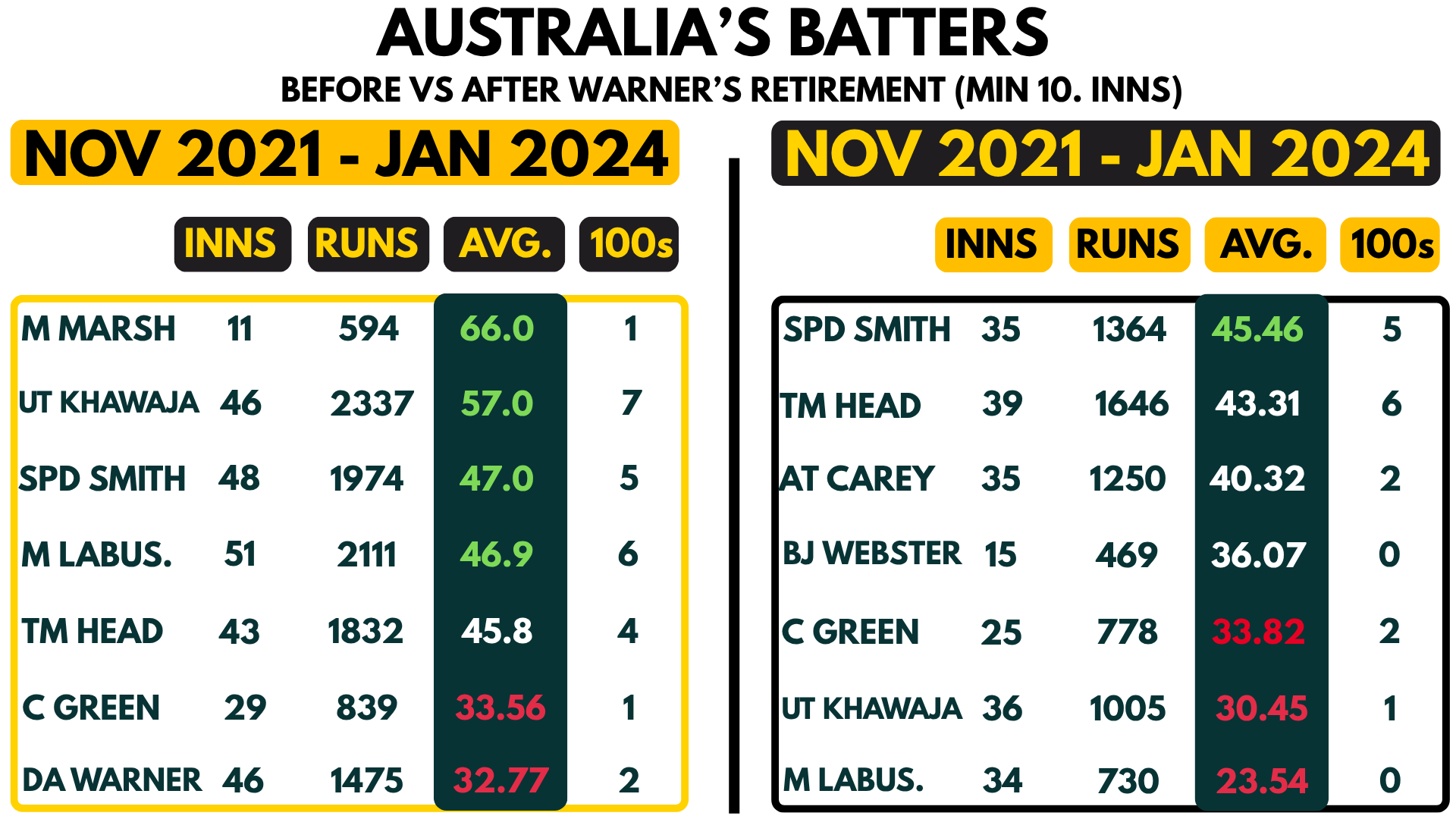
Take a look at the batting first. Since Cummins took over until David Warner’s retirement, Australia had 5 batters averaging over 45: Mitchell Marsh, Usman Khawaja, Steve Smith, Marnus Labuschagne, and Travis Head. In fact, David Warner was the only pure batter who averaged below 35.
However, since Warner’s retirement in early 2024, only Steve Smith averages above 45. Warner’s retirement itself had a significant domino effect; Australia tried out Smith, Labuschagne, Head, McSweeney, Konstas, and Weatherald, as Khawaja’s partner up top, and none of them really worked. Khawaja’s own batting form dipped, as he averaged just over 30 since Warner’s departure.
Travis Head finally seemed to solve this issue with his magnificent, game-changing century in the first test of the Ashes last year. However, Khawaja retired after the 5th and final test, leaving another opening spot up for grabs.
Importantly, the three debutants blooded in this experiment - Nathan Mcsweeney, Sam Konstas, and Jake Weatherald - only got 14 tests between them, with Weatherald having the most at 6 games. None of them got a truly extended period with the Aussie side to get accustomed to the demands of test cricket. Once again, Australia seem to be making the same mistake pushing Matt Renshaw to the top of the order. One can only hope they will give him a longer rope.
Labuschagne and Green have also come under scrutiny. Labuschagne averages just 28 since Warner retired, with Green not far ahead at 33. While Green may have bought some time with his crucial century against Bangladesh last test, Labuschagne has been on thin ice.
At the same time, though, very few batters seem to be tearing the door down to break into the side. Matt Renshaw was the only batter not in the national set up to finish last season’s Sheffield Shield with an average over 40. Among the top 10 run getters, Kurtis Patterson’s average of 36 was the highest.
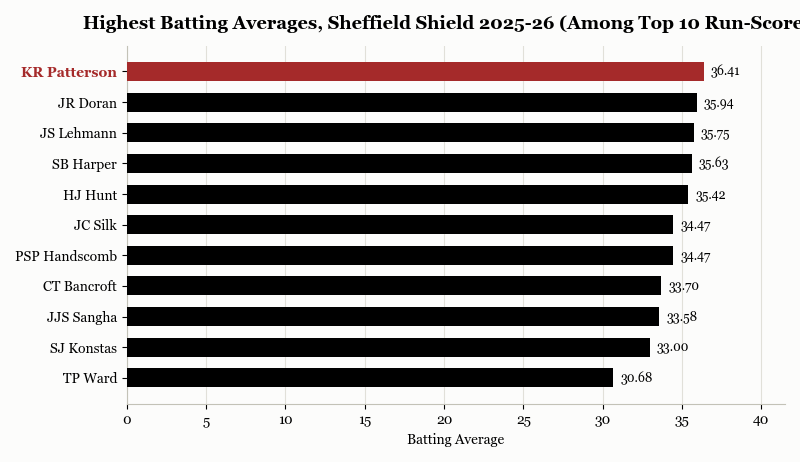
Perhaps a lack of prodigal talent gives room to the current Australian side to rediscover their footing. Still, why the last 3 debutants haven’t gotten extended runs is unanswerable.
The bowling transition is arguably more worrying. Every one of Australia’s tough transitions has been facilitated by a drop off in bowling, and rightfully so. You don’t win a test until you pick all 20 wickets.
Starc, Hazlewood, Cummins, and Lyon have done an exceptional job over the last decade, especially since Cummins took over captaincy in 2021. Australia are the only team with four pacers having a bowling average 25 or under in this time. No other team has more than two, among bowlers with at least 60 wickets in this time.
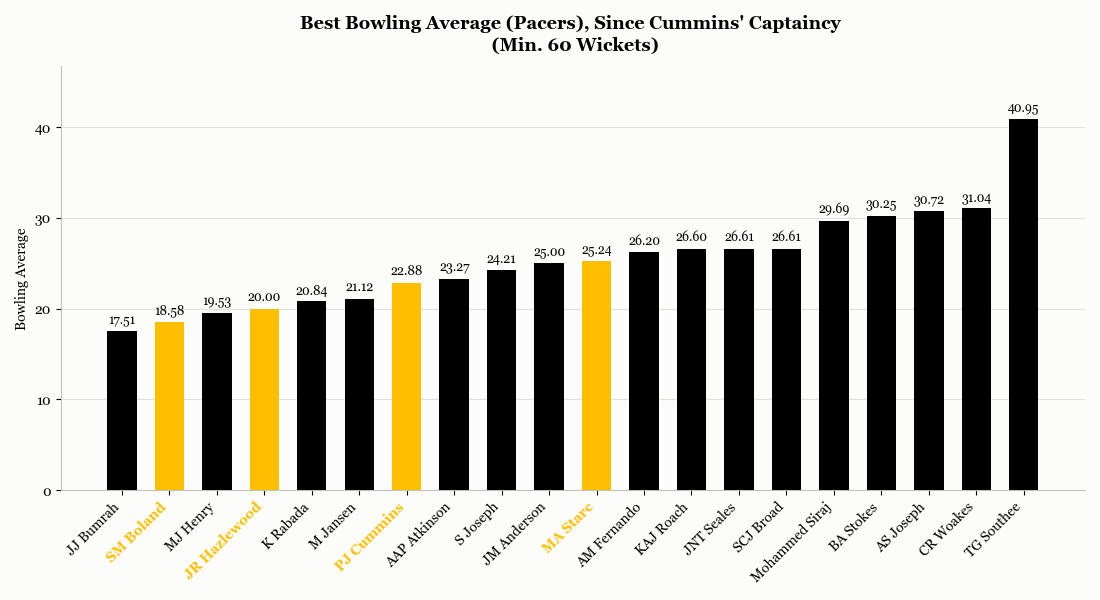
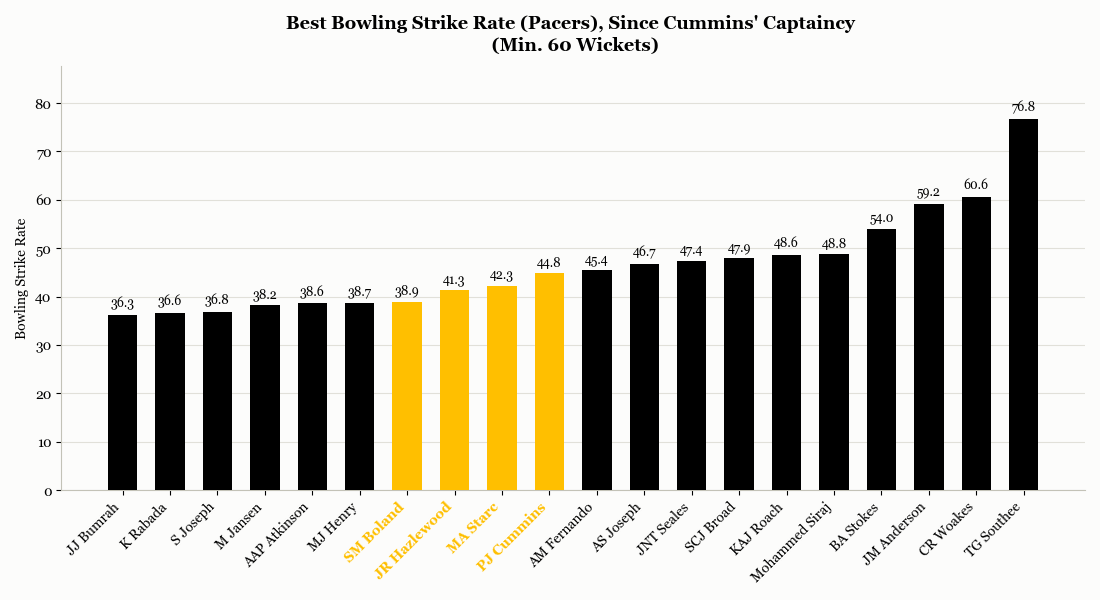
All of Australia’s pacers also pick a wicket every 45 balls or quicker. Other teams can only dream of having a bowling attack that is this consistent and lethal all-round.
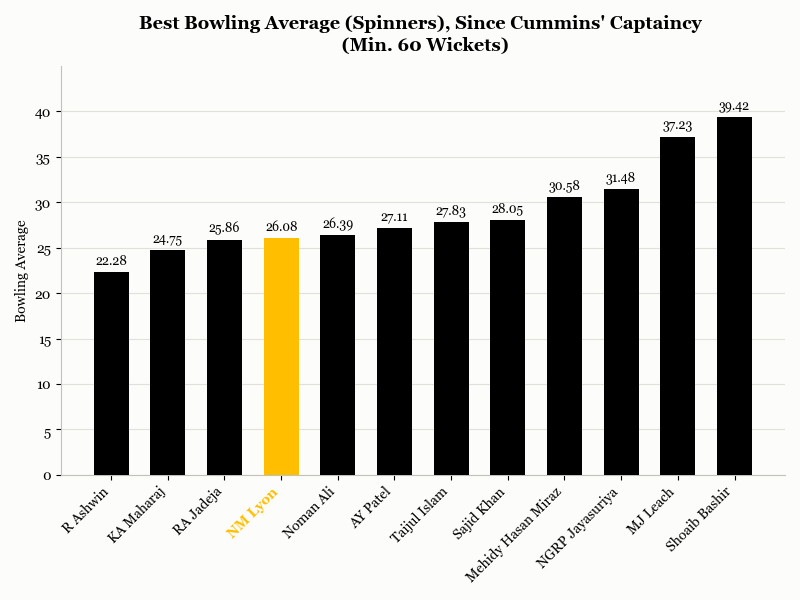
Nathan Lyon has more than held his own, too, with the fourth best average for a spinner in this time, outstanding given he plays most of his games without spin-friendly conditions.
Whether it was Iron Man Mitchell Starc’s unforgettable Ashes 2025, Pat Cummins bringing himself on to pick a crucial wicket and break a partnership, Boland ripping through India in the 2024/25 Border-Gavaskar Trophy, or Hazlewood stepping up in tough conditions, the cartel has bailed Australia out of several close games. This would be the ideal time for Australia to rope in newer batters and give them experience, under the shield of an in-form, premier bowling lineup. Yet with every test, it seems the batters' places are only more safe, despite a lack of runs.
None of Australia's pacers are younger than 33. Cummins and Hazlewood played a combined one test last summer, being sidelined with injuries. Even the backups are getting no younger. Boland is 37, Neser is 36, and last summer’s debutant Brendan Doggett is 32. The cartel may be able to shield Australia's batting weaknesses for another year, maybe two, maybe even three. But when they leave, they will leave a gaping hole in the Australian side, much like in the early 80s and late 2000s.
At the same time, Australia are lost with who will replace Nathan Lyon. Todd Murphy and Matt Kuhnemann have had a go in the test circuit and held their own. Both have had successful tours in the subcontinent, particularly Kuhnemann in his 2 tests in Sri Lanka where he picked 16 wickets. Kuhnemann also had a solid Shield season last summer, averaging just 21.54 in 7 innings. Australia could also give CJ Rocchicioli a go. The 28-year old finished as the fourth highest wicket taker in the last Shield season, and looks comfortable in Australian conditions, key to becoming a successor to Nathan Lyon.
With every passing test, Australia trudges closer and closer to an inevitable fork. Their schedule has never been more packed; after the Bangladesh series, the Aussies are set to tour South Africa for 3 tests, host New Zealand for 4 tests, tour India for 5 tests, potentially play for in World Test Championship Final in 2027, and play an away Ashes in late 2027. Can the bowlers hold on a packed year of test cricket? Will the batters start producing runs when it matters? Should Australia bring in young blood straight into these important series? The changing of eras was always impending, but it now seems more urgent than ever. How will Australia navigate this transition?