September 26, 2026
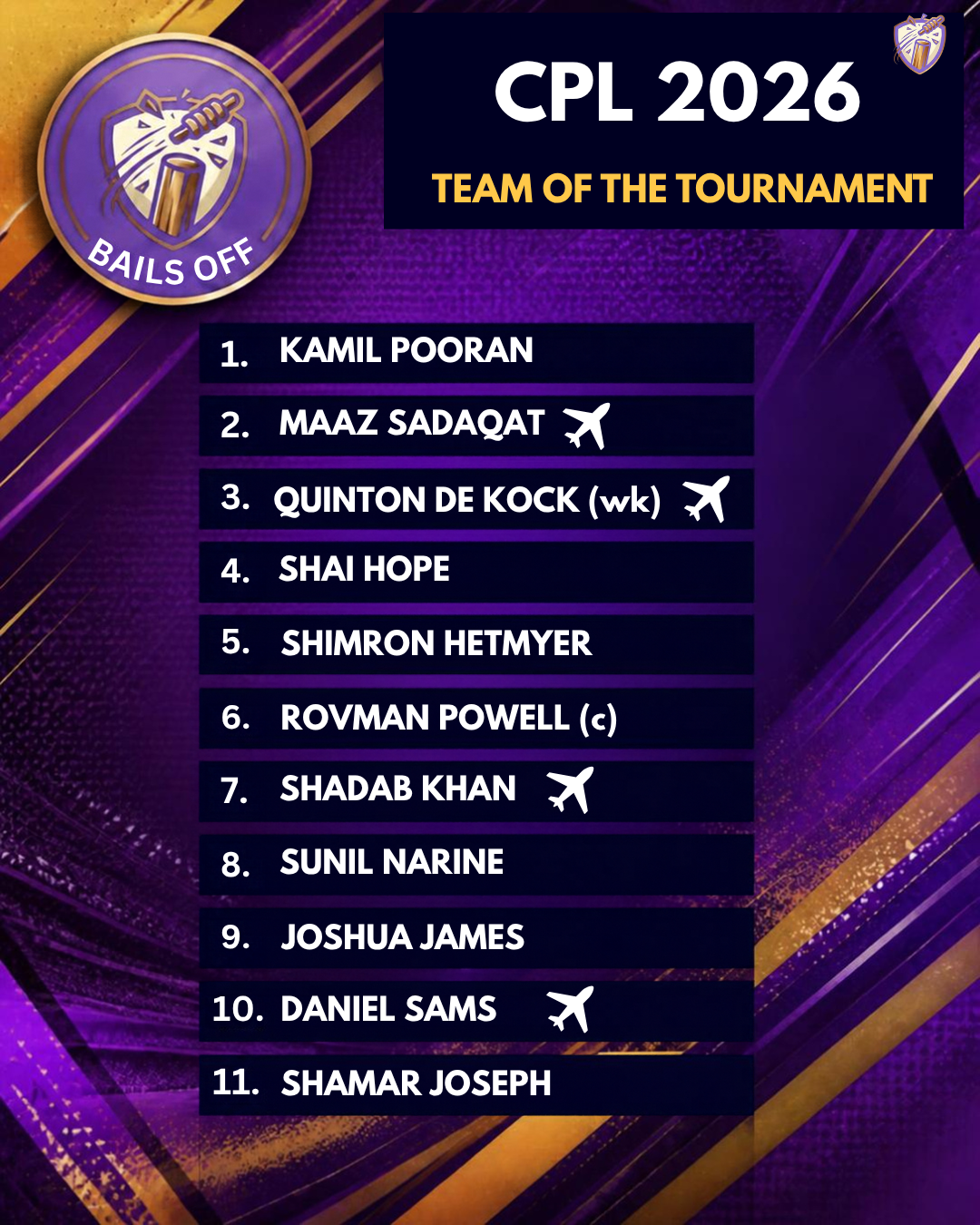
CPL 2026: Team of the Tournament
Picking the standout XI from the 2026 Caribbean Premier League season.
CPL 2026
The 14th edition of the Caribbean Premier League just concluded, and the tournament was bigger and better than ever. The league saw 7 teams compete for the title for the first time, with more games, runs scored, and sixes hit than ever before.
Games were closer than ever before, with eight games being won by 10 runs or less, or by 2 wickets or less.
From the St Kitts and Nevis Patriots crushing the St. Lucia Kings by 137 runs, the biggest ever win in the CPL, to standout debutants like Kamil Pooran and Jakeem Pollard making a name for themselves, we saw two months of intense competition in the Caribbean.
BailsOff presents: the CPL 2026 Team of the Tournament.

Rules
To preface my CPL 2026 Team of the Tournament, here are the key rules I followed:
-
A maximum of 4 foreign players are allowed to make the XI
-
A minimum of 1 youth talent player in the XI
-
The captain must have captained a CPL side this season
-
Players must play the same role, or very close to, the role and position they played for their respective franchise in CPL 2026.
I analyzed every game of this CPL season, with breakdowns for cumulative Group Stage statistics, and weighted match-winning performances, especially in the knockouts.
Here is BailsOff’s CPL 2026 Team of the Tournament:
Openers
The first of the opening slots has to go to Kamil Pooran, this season’s breakout player.
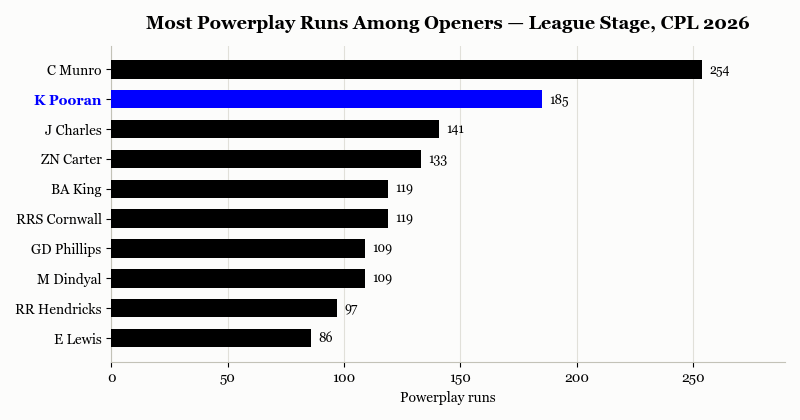
Among all openers in the Group Stage, Pooran had the second highest runs in the powerplay, at 185, despite playing only 8 games this season.
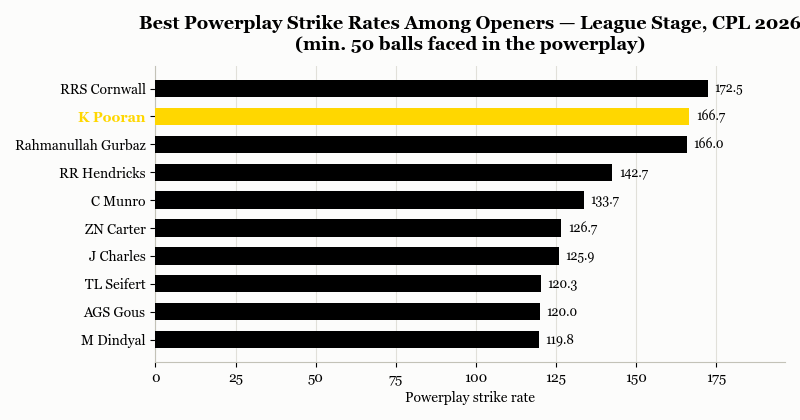
Pooran also managed the second best powerplay strike rate of 166.7, only behind Rahkeem Cornwall among batters with at least 50 balls faced in the powerplay this season.
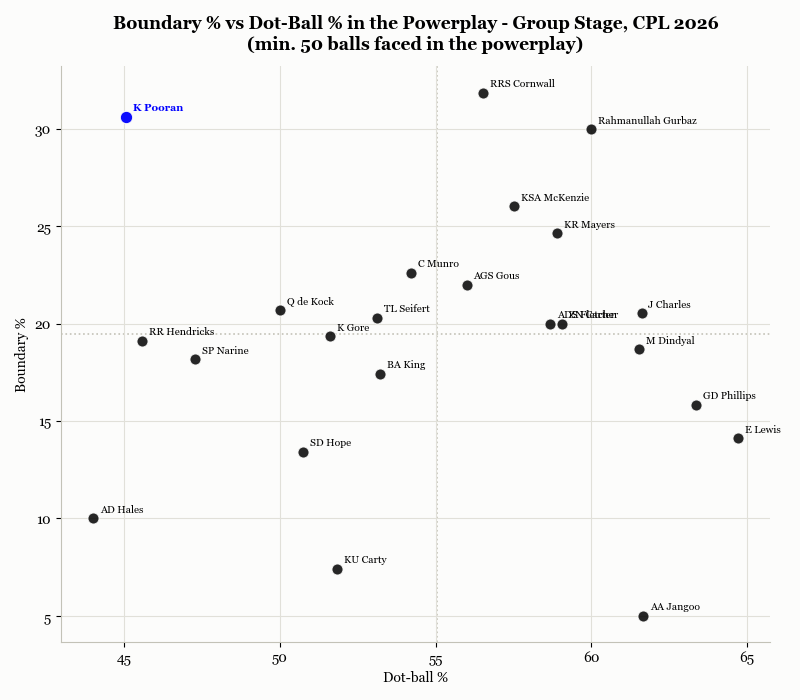
Look at the Boundary % vs. Dot-Ball % for openers in the powerplay of this season’s Group Stage. Pooran has the best optimization of minimizing dot balls and maximizing boundaries, with the second-lowest dot-ball % and the second-highest boundary % in this phase.
The other opener I’ve gone with is young Maaz Sadaqat from Pakistan. He only got an opportunity towards the back end of the Jamaica Kingsmen’s season, but had a fantastic run in the knockouts. He finished the season with the third most runs at 363, despite playing just 7 games.
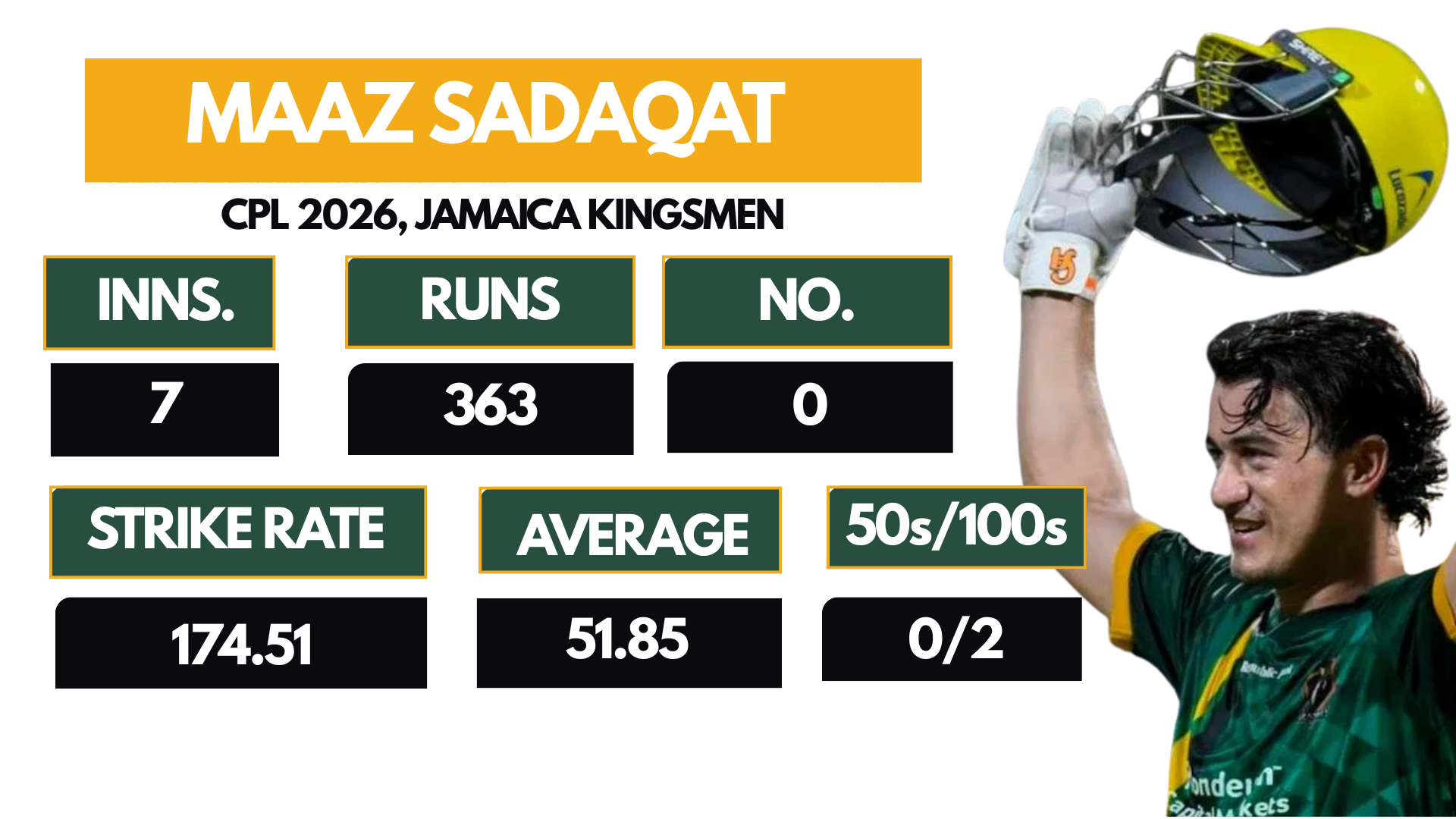
Sadaqat also broke the record for the most runs in a single playoff run in the CPL, with his unbelievable two centuries in three games, as he became the CPL’s youngest ever centurion. Sadaqat’s inclusion was a no-brainer.
Sadaqat and Pooran together at the top give this team a solid left-right hand combination to open the innings.
Colin Munro was a close call, given he had the most runs among openers in the Group Stage, but was pipped by both Pooran and Sadaqat when it came to scoring rate in the powerplay.
Middle Order: 3, 4, 5
At number 3, Quinton de Kock was the obvious choice. The left-hander finished as the leading run-scorer in CPL 2026, with his 392 runs in 11 innings.
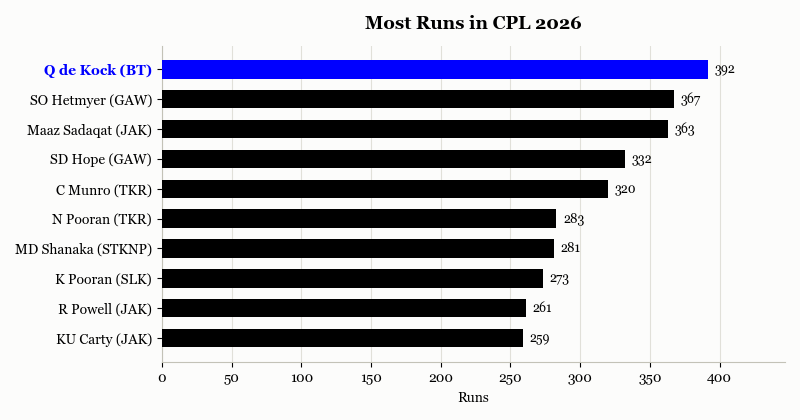
He is joined by Shai Hope and Shimron Hetmyer at number 4 and 5 respectively, who featured 4th and 2nd in the most runs in this season’s CPL.
Looking at this trio in the middle overs of this season’s group stage, we see Hetmyer had by far the most aggressive approach, with the lowest dot-ball % and highest boundary % in this phase.
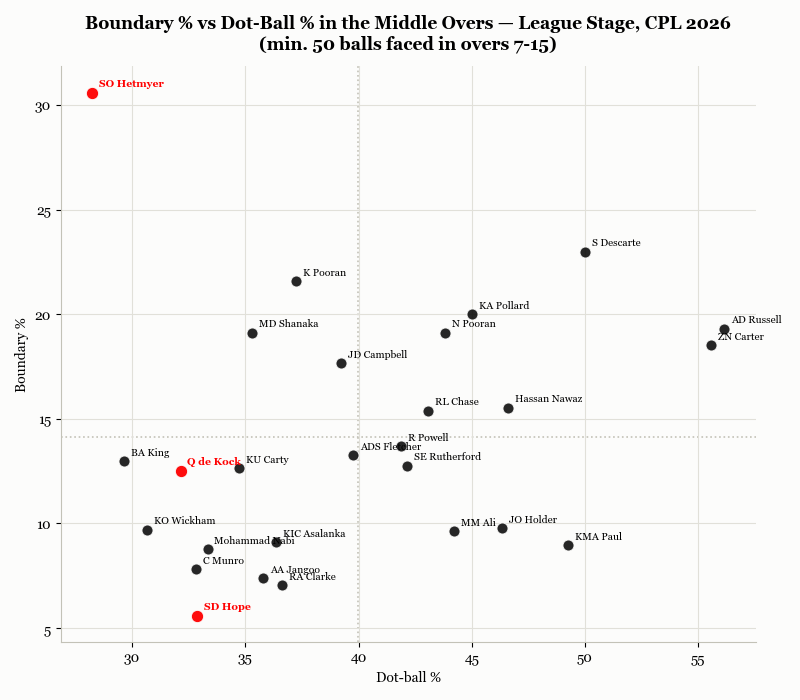
He is supported well by de Kock and Hope, both of whom have a middle-overs dot-ball % under 35, and were crucial in consolidating the innings of their respective teams.
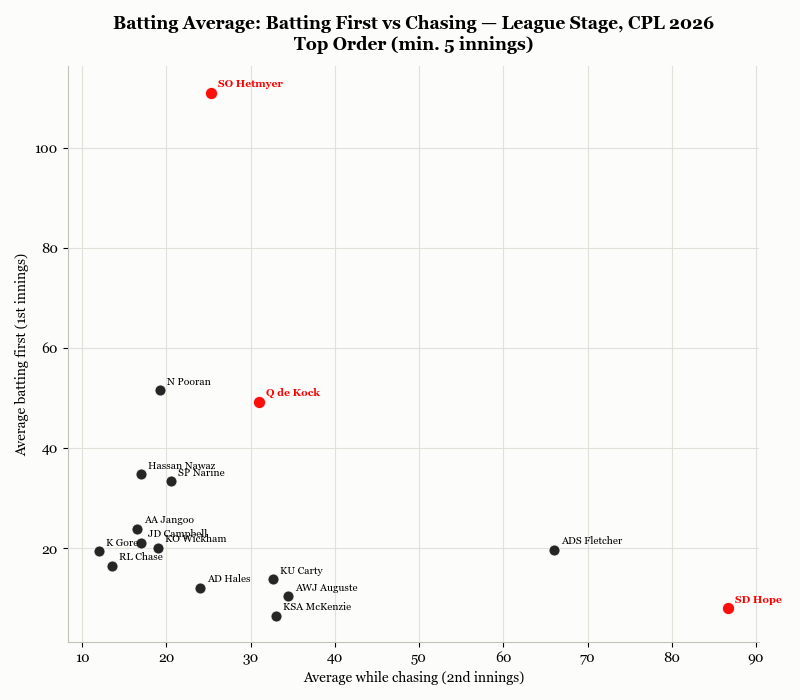
Among middle order batters, Hetmyer had by far the best average while batting first, at over 100, while Shai Hope had the best average while chasing, at around 86.0, in this season’s Group Stage. Quinton de Kock was consistent across both innings, averaging close to 45 in the first innings, and above 30 in chases. With a balance of strengths in setting totals and chasing them down, this trio provides immense stability to the Team of the Tournament.
Nicholas Pooran was a shout for the Number 3 slot in this team, given he ended the Group Stage as the third-highest run scorer, only behind de Kock and Colin Munro.
However, Pooran wasn’t nearly as effective as de Kock, Hope, and Hetmyer in the middle overs, due to the fact that he often had to soak up pressure after low-scoring starts from the Knight Riders. His dot-ball percentage of 44% in the middle overs left him out of this side.
Captaincy
At number 6, Rovman Powell slots into the team of the tournament as the skipper. Powell was handy with the bat this season, with 261 runs in 12 innings, remaining not out on 3 occasions as he saw the Kingsmen home.
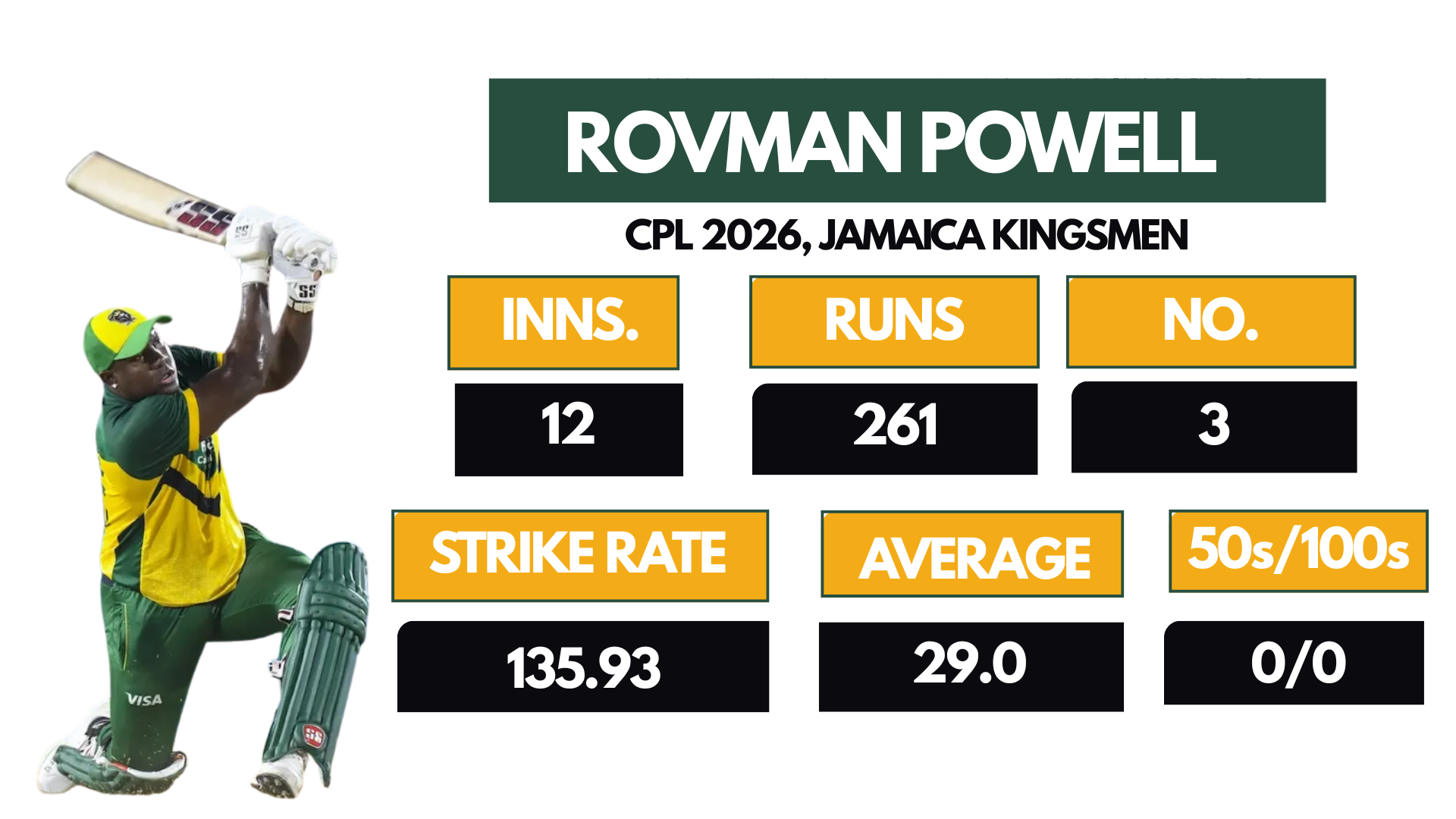
His most impressive outing came in Qualifier 2, where he scored a crucial unbeaten 40 (17) to chase down 207 against the in-form Guyana Amazon Warriors and book a spot in the finals in the team’s first ever CPL season.
Powell was very impressive as a captain this season. He led a newly established team to their first ever final, after they lost their first three games on the trot this season. They sealed back to back wins in the Eliminator and Q2 to find the finals, a feat most teams fail to accomplish. Although Powell didn’t bowl at all this season, his captaincy and clutch batting performances found him a slot in this team.
Lower Order: 6, 7, 8
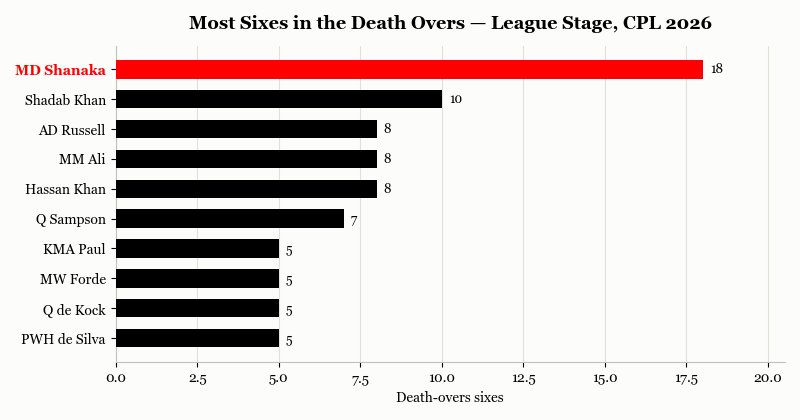
With Rovman Powell at 6, Dasun Shanaka was unlucky to miss out on the Team of the Tournament, despite his exploits at the death this season. Shanaka finished with by far the most sixes in the death overs in this season’s group stage, at a staggering 18 sixes. He also remained not out on 3 of his 8 innings, bringing the Patriots home in crucial chases. He smashed the CPL’s fastest hundred in 39 balls when the Patriots crushed the St. Lucia Kings by 137 runs.
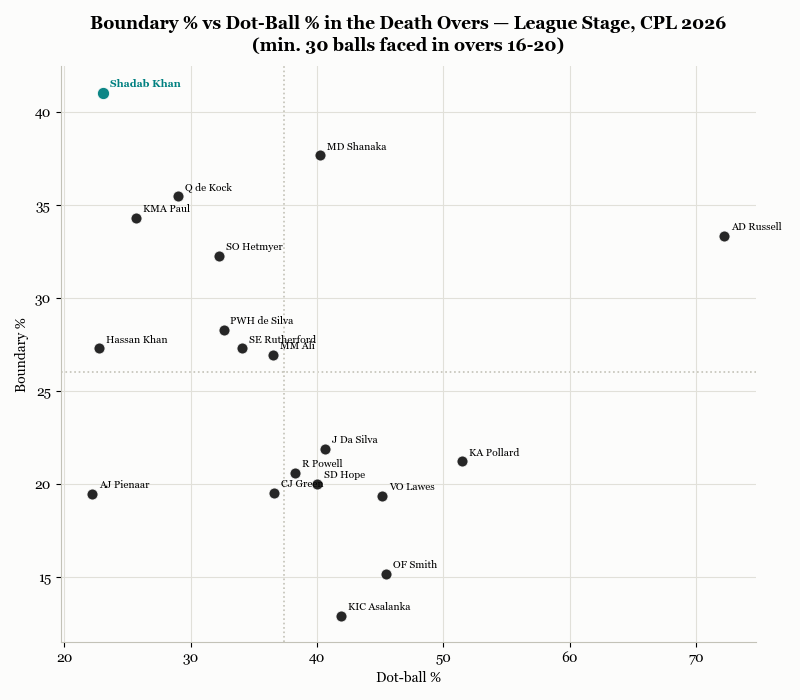
Shadab Khan unsurprisingly finds a slot at number 7. The Player of the Tournament was valuable with the bat at the backend, with the highest boundary percentage of 42%, and a dot-ball percentage of just 24% in the death overs in this season’s group stage.
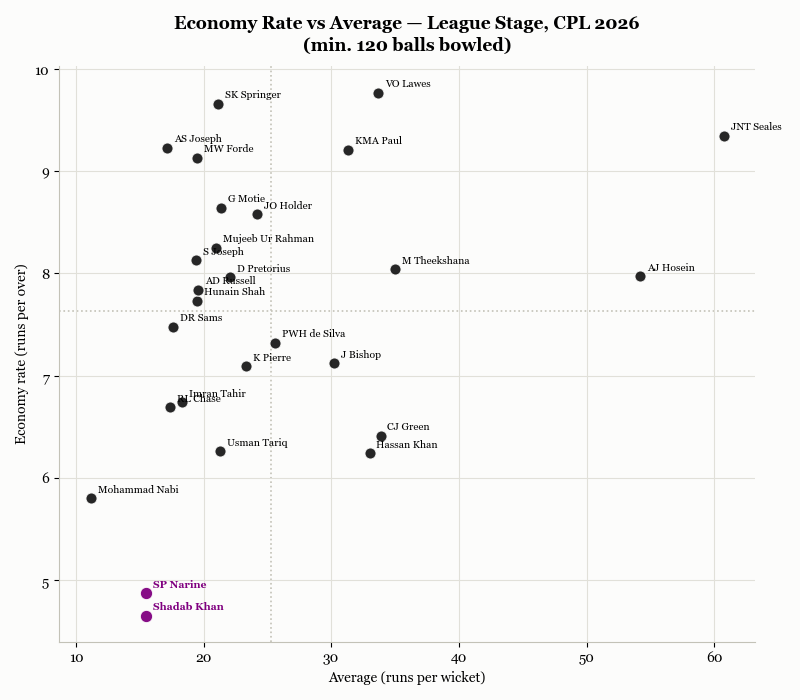
With the ball, Shadab Khan was even more impressive. Shadab had the best economy rate of just 4.65 in the Group Stage this season, and averaged just 15.5 runs per wicket. His numbers were comparable to the legendary Sunil Narine, which goes to show how vital he was to the Falcons’ winning campaign.
Speaking of Narine, he also slots into the side at Number 8, with another fantastic season with the ball. He continued his newfound role as a powerplay strike bowler this season, picking 7 wickets in the powerplay during the Group Stage. Matthew Forde came close to breaking into the side, pipping Narine on wickets in this phase, but Narine was incomparable when it came to dot-ball % in the powerplay, at over 70%. He also had the second lowest boundary percentage in this phase, under 11%.
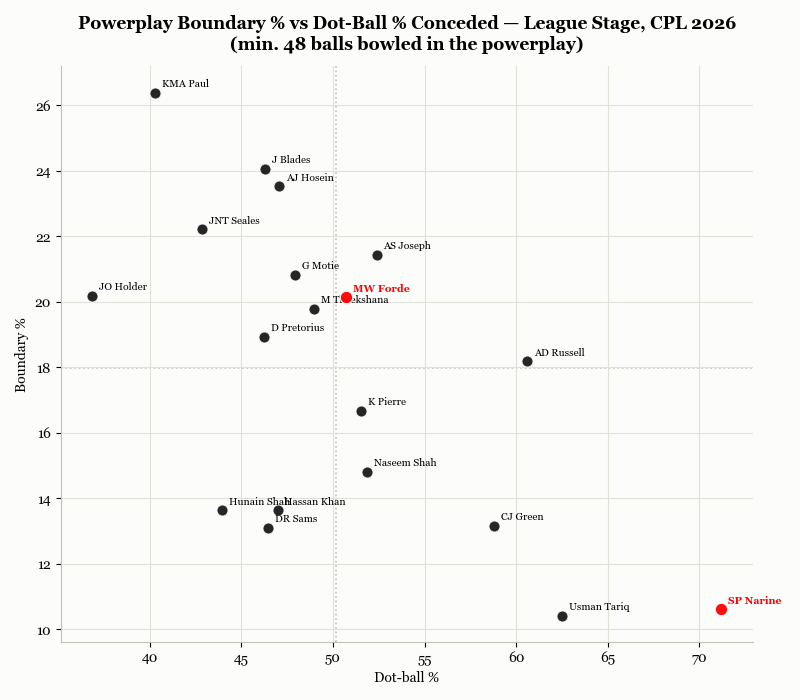
Narine also had a solid season with the bat, with 2 half-centuries in his 182 runs, often sent up the order by the Knight Riders to solve their struggles with openers. His handiness with the bat got him a spot in the team over Forde.
The Tail: 9, 10, 11
The tail of this team is rather long, but should be protected given the strength of the top 8.
Joshua James makes the team at Number 9, as the breakout player of the team.
The youngster picked 12 wickets in just 8 innings this season, at an outstanding average of 12.75, and economy rate at 8.5.
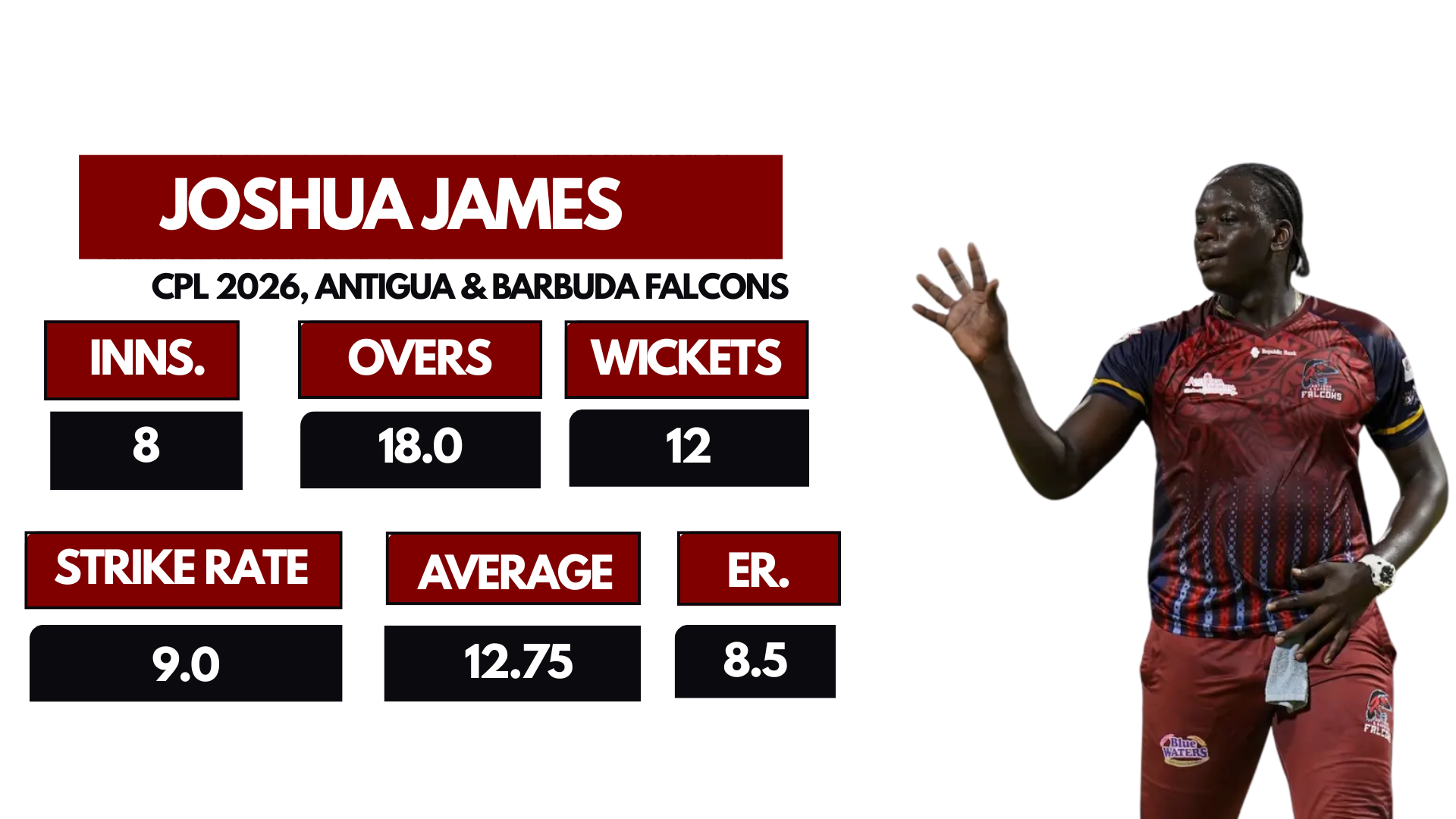
He was relatively underutilized by the Falcons this season, only bowling 18 overs in his 8 outings, but skipper Moeen Ali claimed he was a “captain’s dream”, who came in and nailed his skills every time.
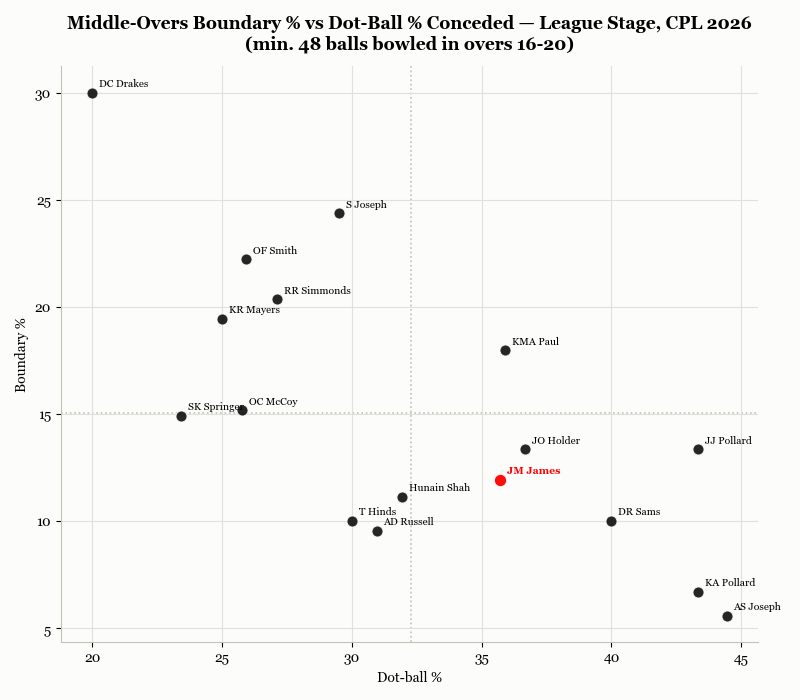
His reliability was proven in the middle overs, where he remained above par on dot-ball percentage and boundary-percentage among pacers in this season’s group stage.
Daniel Sams claims his spot at Number 10 in the Team of the Tournament. He finished the group stage with the 3rd most wickets, and the most for any pace bowler, at 14.
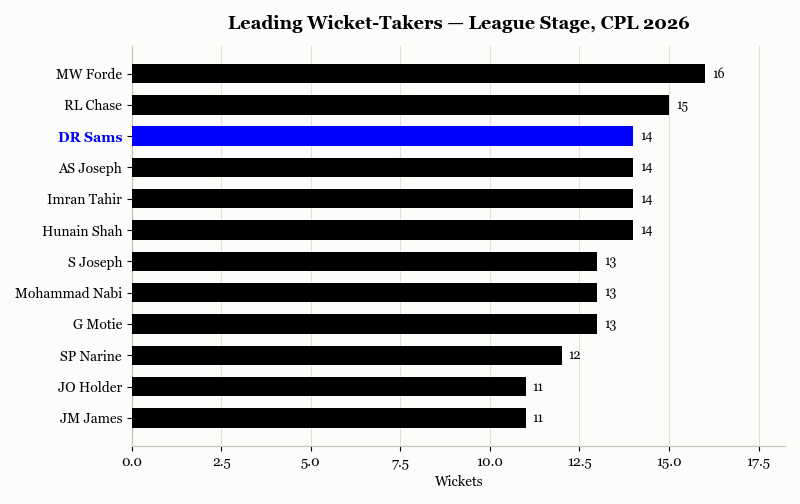
He had the best average for any pace bowler in the Group Stage, at 17.64. He also had the best economy rate among pace bowlers, at just 7.48.
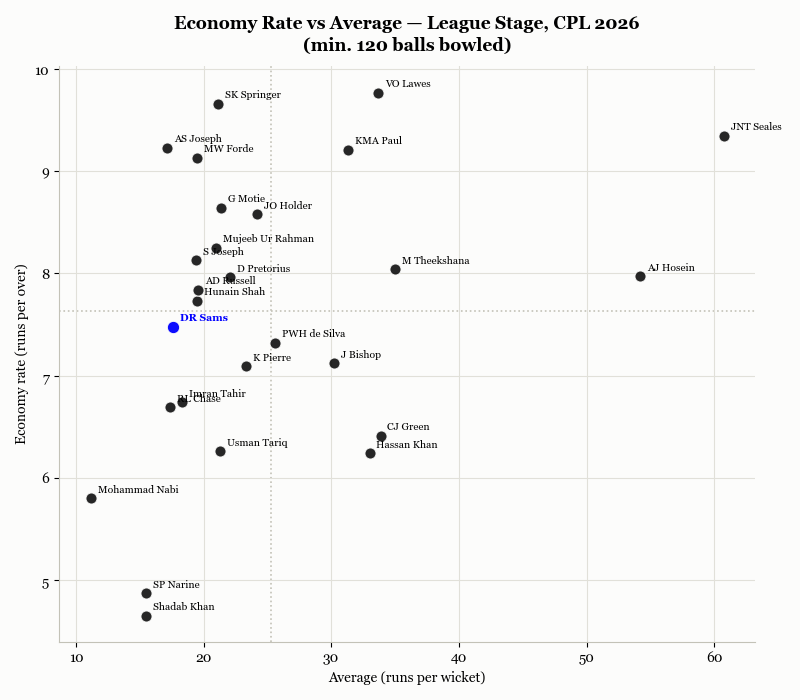
In the powerplay, he managed the lowest boundary percentage of just 13%, while maintaining a dot-ball percentage just under par.
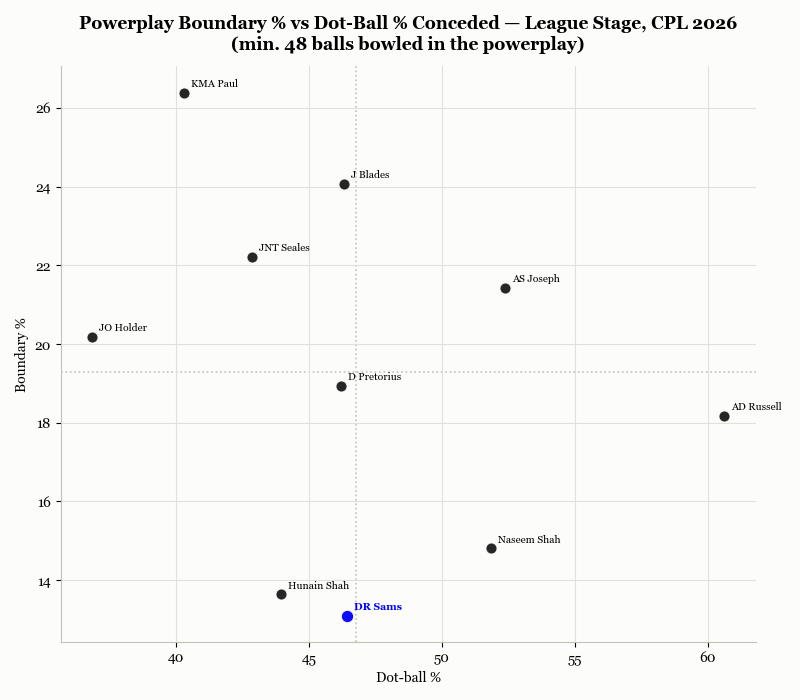
Alzarri Joseph came close to securing a spot here, with 7 wickets in the powerplay during the Group Stage compared to Sams’ 4. However, Alzarri was considerably more expensive than Sams throughout the tournament.
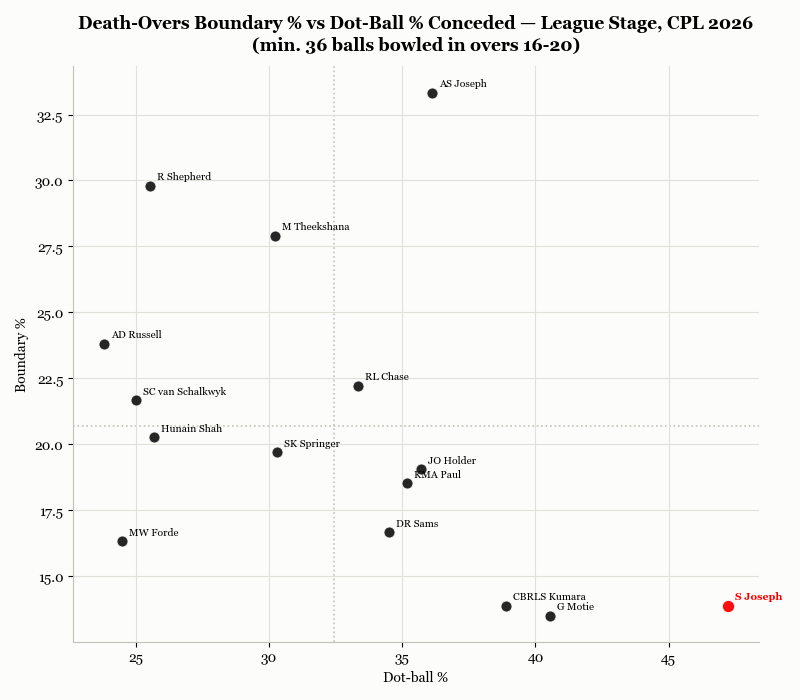
Last but certainly not least, at number 11 comes Shamar Joseph, arguably the most evolved bowler of this tournament. Shamar proved his stripes at the death this season, expanding his arsenal to involve a reliable yorker that he frequented throughout the Group Stage.
Only Husnain Shah picked as many wickets as Shamar Joseph in the death overs during the Group Stage of this season.
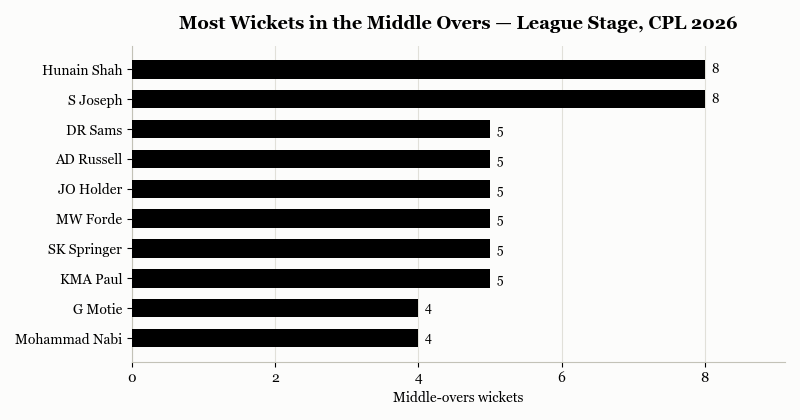
Moreover, Shamar was absolutely unplayable with the highest dot-ball percentage of nearly 43%, among bowlers with at least 36 balls in the death overs this season. He dominated this phase, and seemed to be the only pace bowler in the entire tournament who was able to do so.
Team of the Tournament