
September 3, 2026
The Lost Flair of Pakistan Cricket
Spirit, Flair, and Character have defined Pakistan Cricket forever. So when a Pakistan side turns up to England for a 3-test series, but doesn't even try to put up a fight in the first test, eyebrows are raised. Join a deep dive into the Lost Flair of Pakistan Cricket.
Introduction
Pakistan are the Brazil of cricket. The flair and free-flowing nature of their gameplay, the superstars and personas, and the expectation of Brazilian football manifest themselves within Pakistan’s cricket.
Brazil has had Ronaldinho, Pele, even Neymar Junior. Pakistan has had Javed Miandad, Shoaib Akhtar, and Shahid Afridi.
The Spirit of Pakistan Cricket
The raw talent in Pakistan is undeniable. Express pace, fearless batting, and spirited performances defined Pakistan cricket for decades. In the 1992 Cricket World Cup, Pakistan won just 1 of their first 5 games, and were nearly down and out within the group stage. Skipper Imran Khan famously donned the iconic tiger t-shirt, bravely inspiring his team to “play like cornered tigers”. And Pakistan did just that. They beat Australia, then Sri Lanka, then New Zealand, then New Zealand again in the semis, and finally beat England in the finals. 5 straight wins to claim their first ever World Cup trophy.
From the swing kings Wasim and Waqar, to the elegance of Inzamam-ul-Haq, to the mystery of Saqlain Mushtaq, Pakistan had no shortage of icons. Heroes that fans of Pakistan, and of cricket worldwide, would look up to in awe.
Pakistan’s dominance doesn’t just live in tales of the past. It was just 2016 when skipper Misbah-ul-Haq lifted the Test Mace as Pakistan climbed to the top of the Test rankings. It was just 2017 when Mohammad Amir ripped through an undefeated India’s top order, and Fakhar Zaman’s century sealed the Champions Trophy. It was just 2022 when Pakistan qualified for the 2022 T20 World Cup finals, and nearly claimed their second title.
So where did it all go wrong?
A Change of Eras
From 2012-2018, Pakistan were good in Tests. They were nowhere near invincible, but they competed. Even with their backs against the wall, they showed spirit and fought till the end, and saw a brief moment of glory when they claimed the Test Mace in 2016.
Under Misbah in particular, they were strong. Pakistan won 26 Tests under Misbah compared to 19 losses in 57 games. He played in an era with many strong captains: Graeme Smith, Virat Kohli, Michael Clarke, Steve Smith, and Andrew Strauss. Still, he ensured Pakistan were no easy opposition. No other Pakistan captain in this time had a win-loss ratio above 1.0. We could do a whole deep dive into Misbah’s importance as captain of Pakistan. He took a fragmented Pakistan side still recovering from the 2010 spot fixing scandal, and turned them into the Number 1 team in the world.
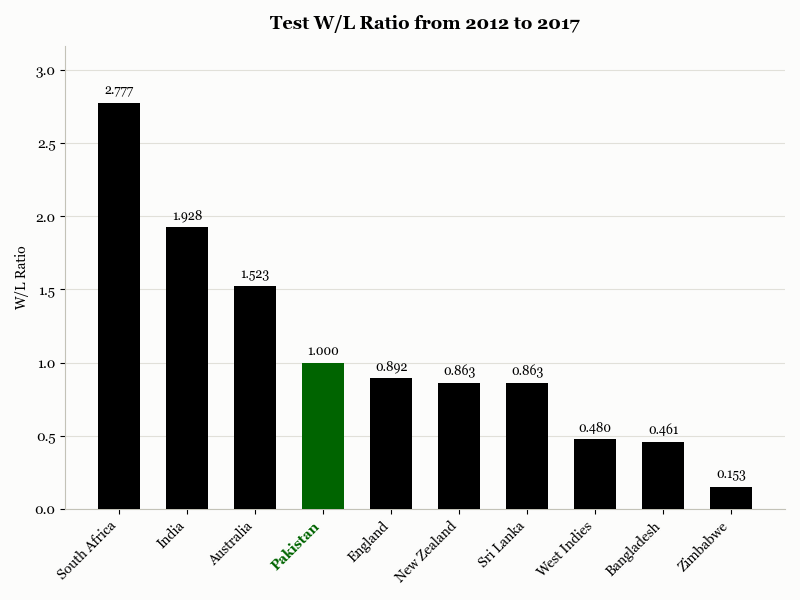
The decline in Pakistan’s Test side was already apparent. In the 5 years before Misbah and Younis retired, they held a neutral Test record with 20 wins and 20 losses from 46 games. They had the 5th best win-loss ratio, a clear notch above England and New Zealand.
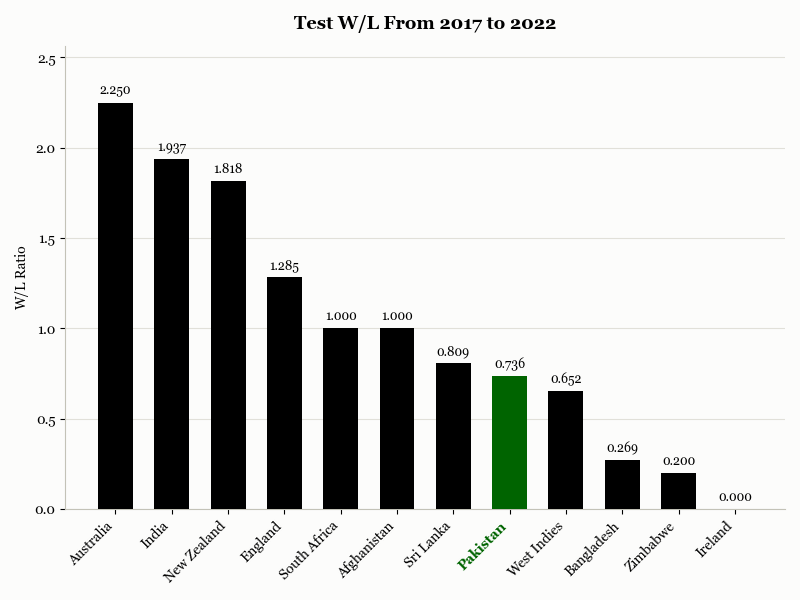
However, since their retirement until the end of 2022, Pakistan won just 14 games, with 19 losses. They fell down to having the 7th highest win-loss ratio among teams with at least 10 Tests played in this period.
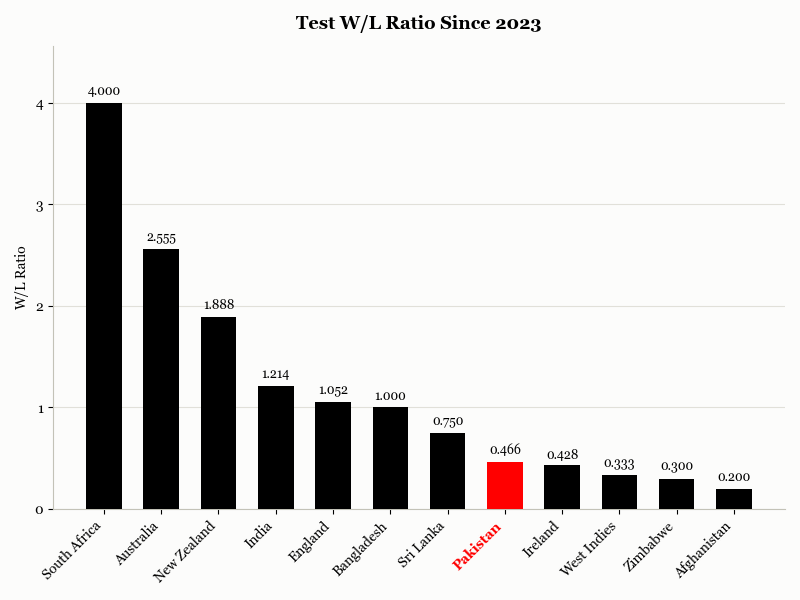
Pakistan’s decline has been even more apparent since 2023, where their win-loss ratio is now just 0.466 in 23 games.
Away from home, their woes worsened. Since 11 May 2017, when Misbah and Younis retired, Pakistan have managed just one single win in SENA conditions, from 19 games.
Pakistan's Batting Downfall
When Misbah and Younis retired, they set in place a batting transition that arguably played a catalyst to the downfall of Pakistan. They lost a reliable leader and two of their most prolific batters after the 2017 tour of West Indies. Mohammad Hafeez retired not long after, and Pakistan allowed a set of younger players to find permanent places in the side: Babar Azam, Mohammad Rizwan, Imam-ul-Haq, and Haris Sohail, among others.
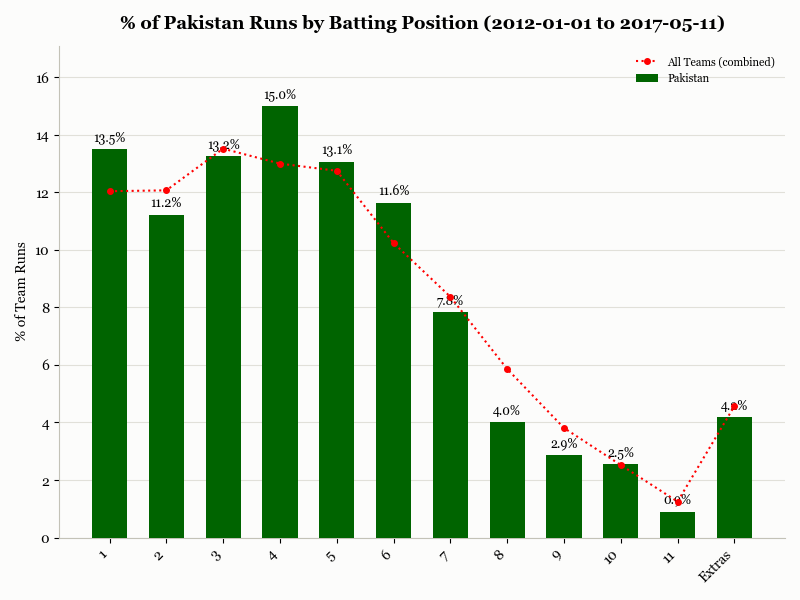
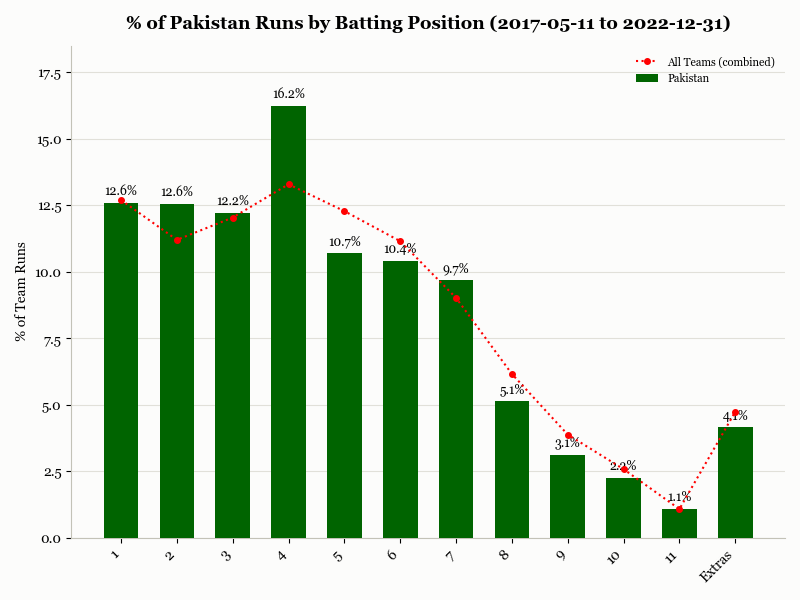
From 2012 to 2017, Pakistan were most reliant on their Number 4 and 6, unsurprising given this is where Younis Khan and Misbah-ul-Haq played the majority of their innings. Younis himself scored 15% of Pakistan’s runs in this time, 2% more than what all Number 4 batters contributed to their team’s totals in this time.
From 2017-2022, Pakistan became even more reliant on their Number 4: Babar Azam. Their middle order slipped below par, and only Azhar Ali at Number 2 contributed runs significantly above par, adding around 1.5% more runs to Pakistan’s scores than the typical Number 2 across all teams. All the other batters were below par.
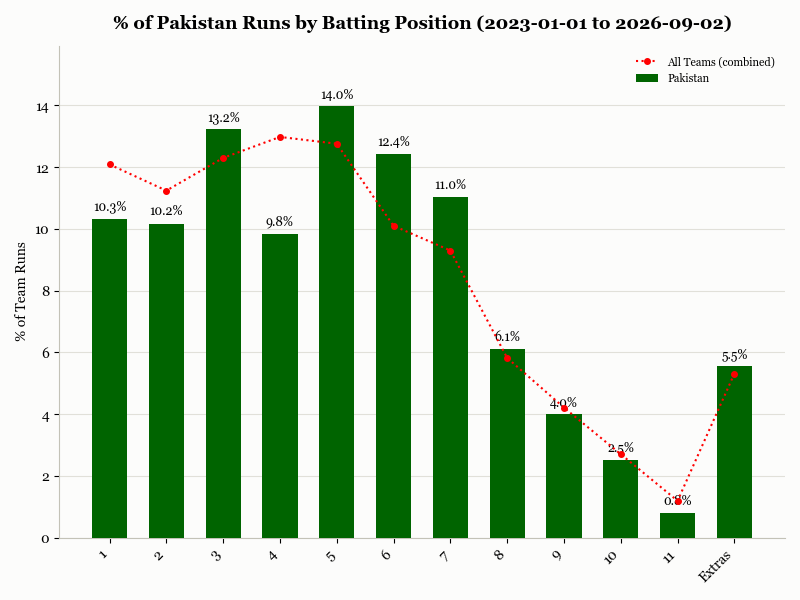
This problem has only been exacerbated since 2023. Pakistan’s openers and Number 4 have been well below par, all contributing no more than 10% each to Pakistan’s totals. It wasn’t even that Pakistan shuffled around the batting significantly; their batters purely stopped performing.
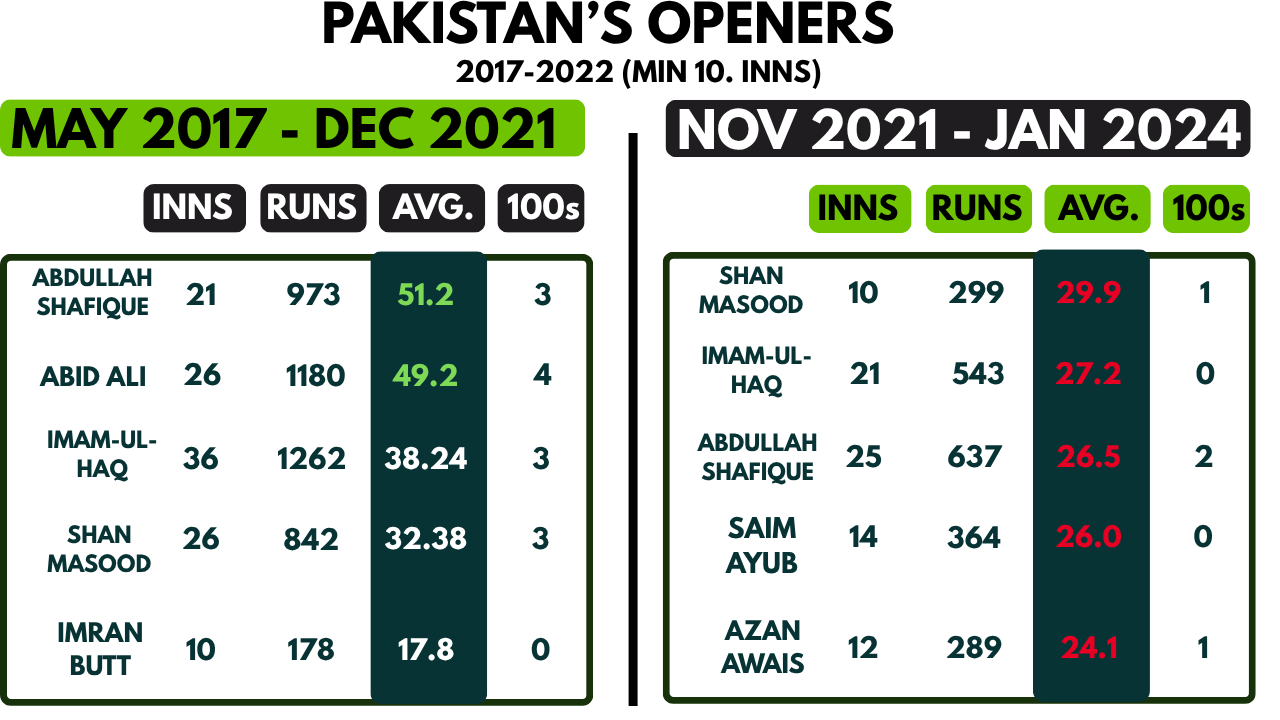
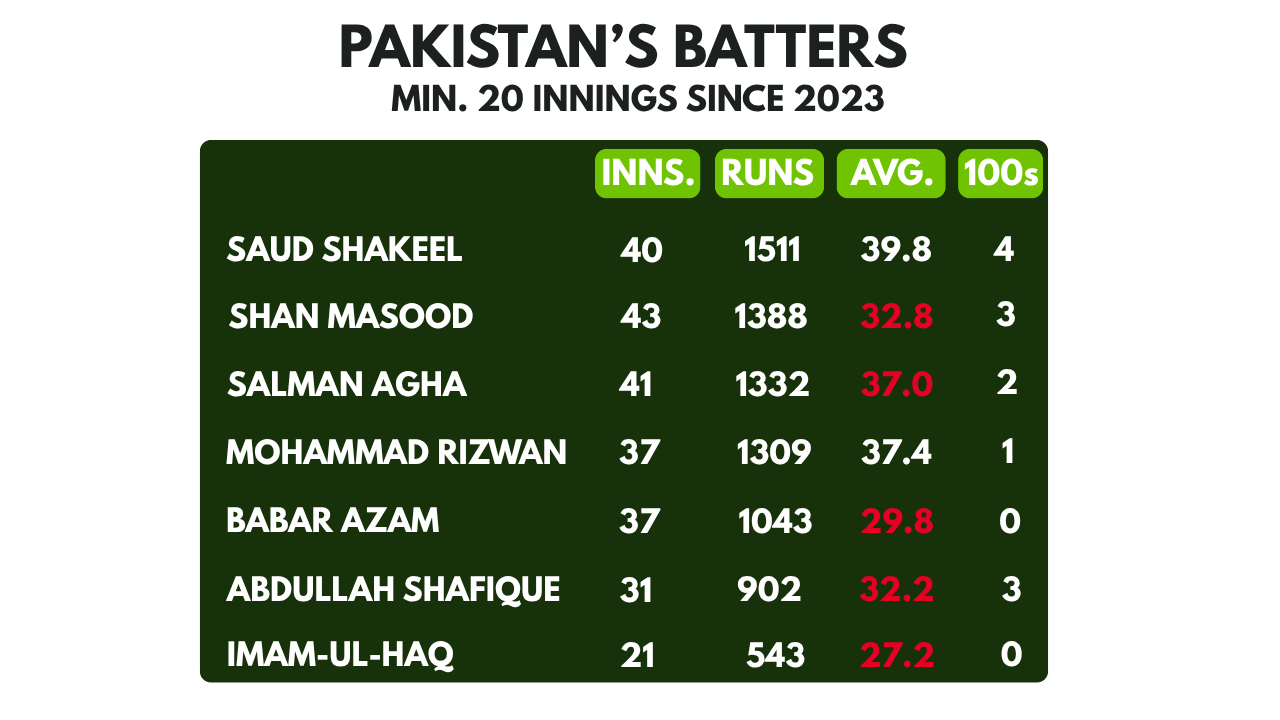
From 2017-2022, Pakistan had four openers with at least 5 innings average over 35, with Abdullah Shafique shining averaging 51. However, since 2023, those very same players haven’t produced the same results. Pakistan’s best opener in this time, Shan Masood, averages just 29.9.
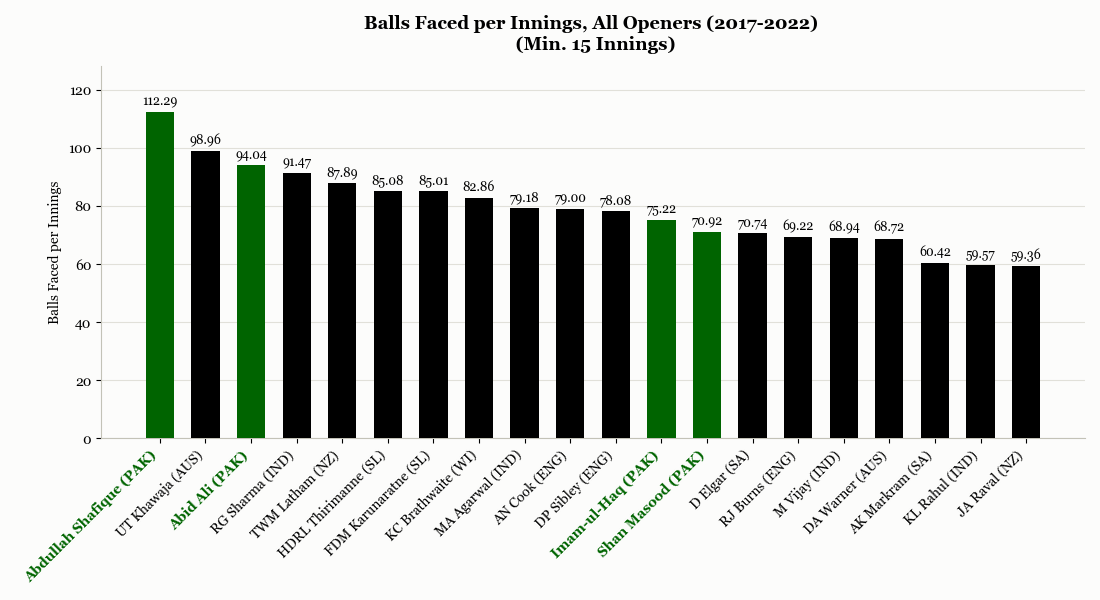
The openers aren’t surviving in the middle either. From 2017-2022, Abdullah Shafique and Azhar Ali had the best and third-best balls faced per innings among all Test openers. They were successfully wearing the new ball down and taking time out of the game, making it easier for the middle order to accumulate runs.
Since 2023, though, no Pakistan opener faces more than 57 balls per innings on average. Only two Pakistan openers rank in the top 20 Test openers for balls faced per innings.
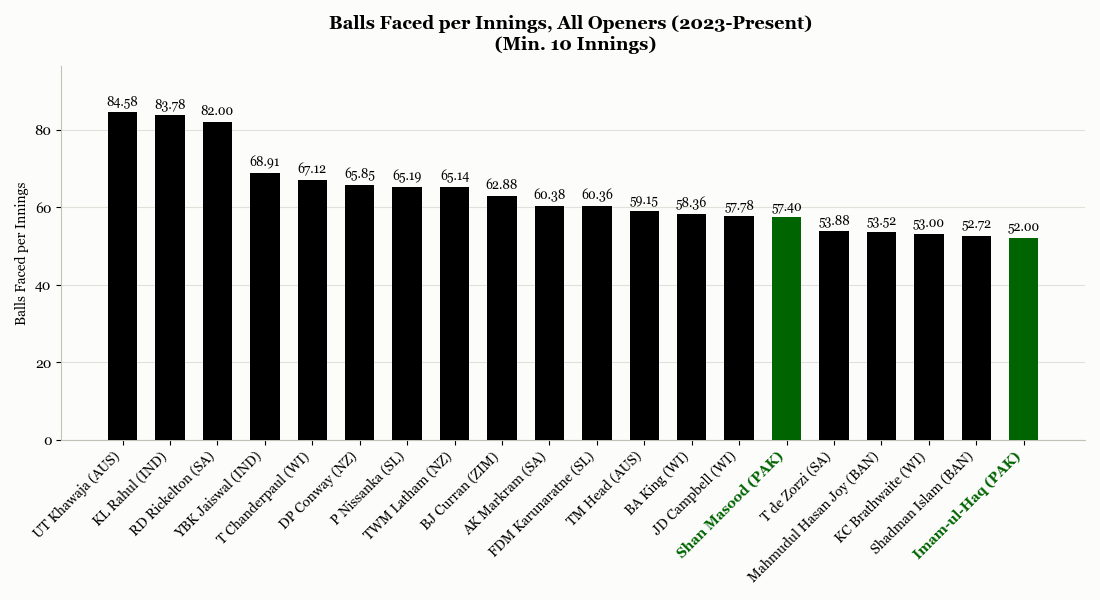
Of course, balls-faced per innings has dropped across the board, with several teams entering a transition phase and searching for quality top order batters, while bowlers get more comfortable exploiting the wobble seam and extracting the most from bowling friendly conditions worldwide. Still, you would expect better from Pakistan’s openers. It seems they are not even half as good as they were from 2017-2022, and they weren’t particularly special then either.
Since his comeback against the West Indies, Abdullah Shafique has been impressive at Number 3 and 4, averaging 66 in his last 6 innings. But he has been just about the only hope for an otherwise dismal Pakistan side. Saud Shakeel, too, has stood up on occasion as the lone fighter for Pakistan. But these one off innings won’t cut it if Pakistan seek to make a genuine return to being a Test side worth fearing.
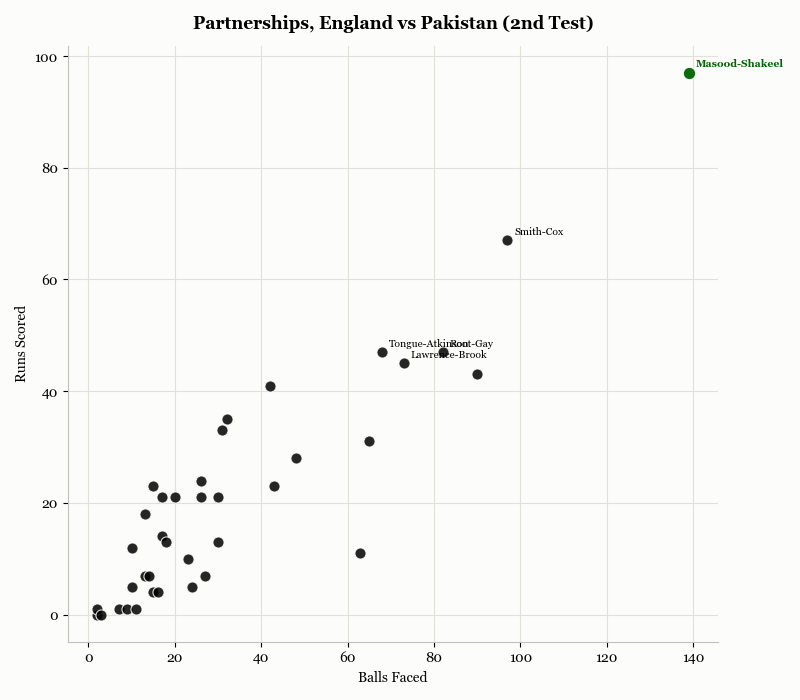
Shakeel’s innings at Lord’s against England perfectly sums up Pakistan’s condition at the moment. For brief phases of play in the second Test, it felt like Pakistan were Pakistan again, fighting for every run. After losing 3 wickets for just 14 runs, Shan Masood and Saud Shakeel put on a gritty 97 for the fourth wicket, the highest partnership of the game, and longest partnership in terms of balls faced, across both teams. Finally, it seemed like the Pakistan batters were willing to dig in and put up a fight.
Then, Masood lost his wicket to one angled in from Ollie Robinson, and it seemed like Pakistan gave up again. As if every batter to come, including Mohammad Rizwan, was just a tailender and all hope was lost. Shakeel didn’t try to soak up pressure or take more strike, didn’t try to shield the new batter or put the bowlers off their length, and the new batters weren’t willing to spend time out in the middle.
Rizwan got out to a shabby, wild slog sweep where he didn’t even want to look at the ball before swinging. Wickets kept tumbling, but Pakistan didn’t care to fight. Even Shakeel himself, who was not only nearing the incredible personal milestone of a century at Lord’s, but was the only in-batter who had the opportunity to pull off something incredible, lost any intention of spending more time in the middle.
When Root’s men initiated the Short Ball ploy, Shakeel went after every one. Sure, he hit Tongue for a few boundaries and maximums. But he barely missed the edge on many occasions, and with a packed legside field, surely Shakeel on 97 would choose to duck and weave, wait out a few more overs and tire the bowlers.
Shakeel instead kept swinging, and eventually holed out to Harry Brook, just 3 runs short of a ton at Lord’s.
After Pakistan’s loss at Lord’s, Mohammad Yusuf didn’t hold back on Twitter. He claimed that irresponsible coaching is to blame for Pakistan’s batting decline in the last decade, and that a pool of talented players could have achieved far more if they were able to improve their abilities and grow as players.
Pakistan's Curious Bowling Attack
Pakistan’s bowling attack is in just as much turmoil as the batting, despite standout talents and individual performances.
From 2019 to 2022, even after Pakistan no longer had Wahab Riaz and Mohammad Amir, they had reliable pacers to turn to. A young Shaheen Shah Afridi spearheaded the attack, supported by Hasan Ali, an incoming Naseem Shah, and occasionally Mohammad Abbas. While they weren’t world changing, they were settled as an attack and had depth. Shaheen’s left arm pace and the ability to swing the ball both ways, Hasan Ali’s exploits with the old ball, and Naseem Shah’s raw talent in any phase of the game, where he could produce remarkable spells. They were supported by a late-stage Yasir Shah, as well as Noman Ali who had just broken into the side.
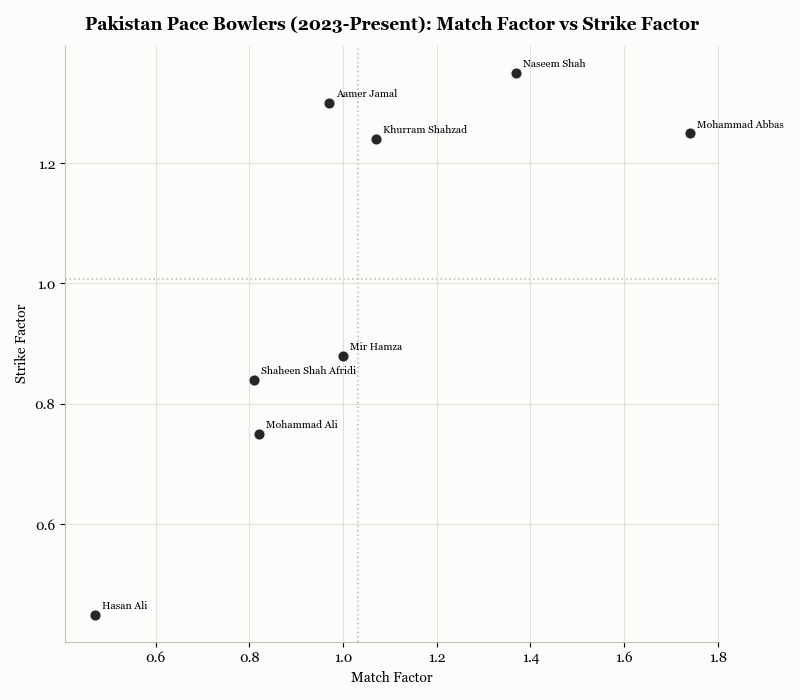
Among Pakistan’s pacers, Shaheen Shah Afridi was by far the most reliable. Pakistan had three pacers with at least 15 wickets above par on Strike Factor, getting wickets more frequently than the average pacer, and two above par on Match Factor.
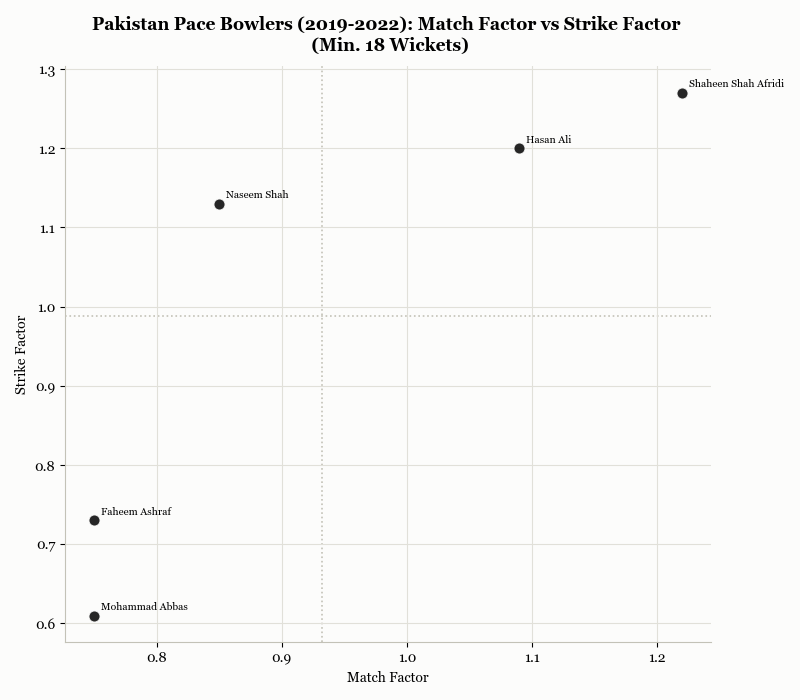
However, since 2023, Pakistan hasn’t had that sort of settled pace attack. Afridi has been in and out of the side, with just 9 Tests to his name where he was 19% more expensive per wicket, and took 16% more balls per wicket, than the average pacer in his games.
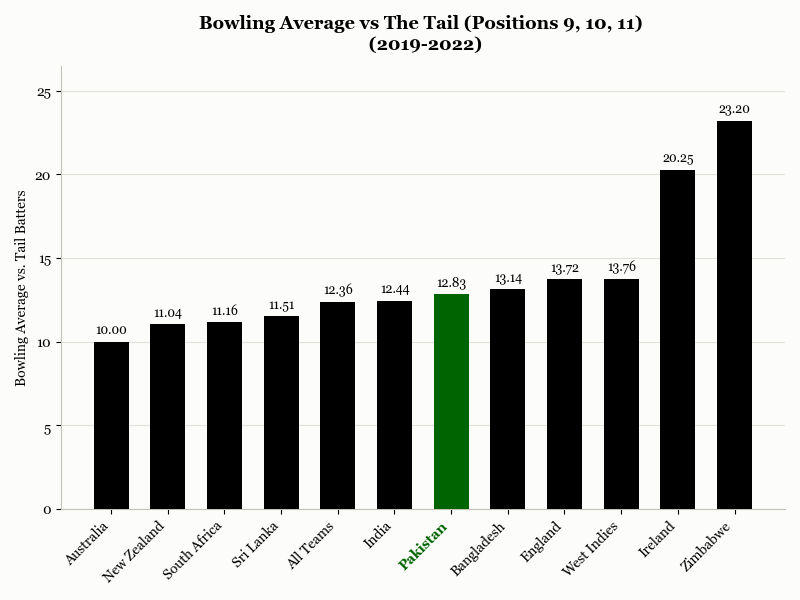
Another concern is Pakistan’s bowling against the tail. From 2019-2022, they averaged just 12.83 with the ball against batters 9, 10, and 11, very close to par, which was 12.36 in this period.
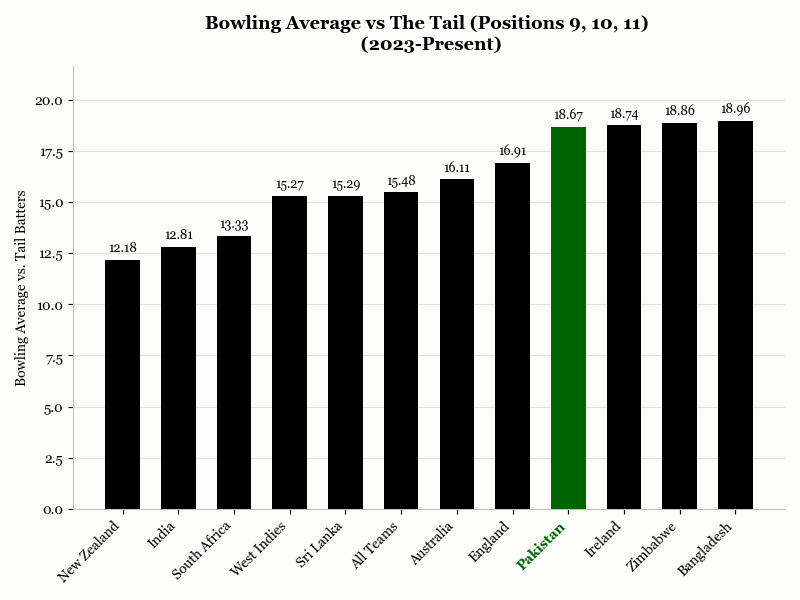
Since 2023, though, the tail has proven to be a challenge for Pakistan’s bowlers. They have the second-worst bowling average against the tail among World Test Championship teams, at 18.67, over 3 runs per wicket more than par at 15.48.
Mohammad Abbas has been the most impressive, with 38 wickets from 7 Tests in this time, and by far the best Match Factor (1.74) and Strike Factor (1.25) among Pakistan’s pacers. But that is where Pakistan is going wrong. Their bowling lineup currently has no depth.
Mohammad Abbas, Mohammad Ali, and Khurram Shahzad were Pakistan’s three frontline pacers in the second Test against England. All of whom bowl around the low 130s, and essentially have the same style with the ball.
Jarrod Kimber put it perfectly in his recent piece, describing Pakistan as “stuck in a cage of orthodoxy”. They’ve become so obsessed with new-generation medium-fast, wobble seam bowlers, that they essentially picked the same bowler thrice. This meant that even when all three bowled well, at Lord’s vs England, there was a clear lack of variety.
What is alarming is that this is not what Pakistan is known for. They are missing the flair, the spirit brought by a range of unique talents they once possessed: Akram, Waqar, Akhtar, even as recent as Mohammad Amir, Umar Gul, Wahab Riaz.
They didn’t even pick their in-form spinner, Sajid Khan, in either of the Tests, and didn’t even bring Noman Ali to England, currently ranked 8th on ICC’s Test bowler rankings.
Shuffling and Shuffling
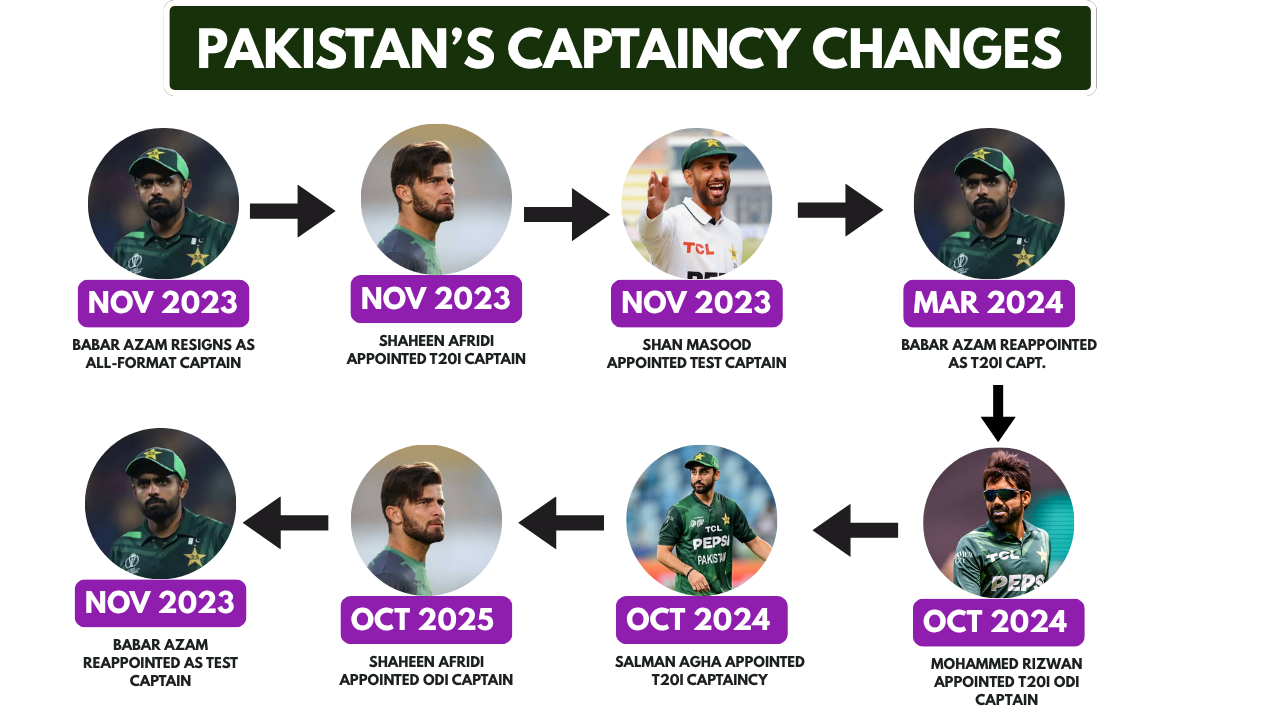
What has been undeniably the most concerning element of this downturn in Pakistan cricket has been the constant chopping and changing. Take a look at their changes in captaincy since the 2023 ODI World Cup. They had Babar step down from captaincy, which put Shan Masood and Shaheen Shah Afridi in charge of the Test and T20I setups respectively. Babar was then reappointed as T20 captain ahead of the World Cup in 2024, until he resigned in October that year, and was replaced by Rizwan as the white ball captain. Rizwan lasted just about a year before Afridi became Pakistan’s ODI captain. Then, Shan Masood was removed from Test captaincy, and replaced by Babar Azam once again as recently as July of this year.
The coaching shuffles have been even worse. Pakistan have had 7 different head coaches since 2022, with Sarfaraz Ahmed being the most recent to be sacked. He was appointed just in April 2026, and has already been thrown out after less than half a year. Mike Hesson is set to take over Pakistan’s red ball side as well, but who knows how long that will last given Pakistan’s track record.
Along with Sarfaraz, an appalling seven players have been dropped mid-series, ahead of the third Test vs England. Past players Shahid Afridi and Mohammad Yusuf openly expressed their disappointment with these decisions, and rightfully so. How can Pakistan cricket expect consistency and success when their players and coaches can’t trust their own positions?
Can Pakistan Rediscover Their Flair?
The Pakistan Cricket team of today seems to be trying too hard to fit into something they cannot replicate. Other teams’ methods of success, their own past glory, or something else entirely. In wanting magic moments so badly, it seems they have forgotten to try at all, a feeling encapsulated all too well in the first Test against England.
With every World Test Championship cycle, Pakistan seem to be getting worse and worse. They ended the first cycle with 43.3 percentage points, then fell to 38.1% the next cycle, then fell again to 36.66% in the previous cycle, and are now at the bottom of the table with just 16.67%.
Since 2023, they have just won 7 of 23 Tests, losing 15. Their away record falls even further, with only one away win in their last 11 away Tests, that too against the West Indies thanks to an incredible performance from Abdullah Shafique.
Is it a case of corruption, complacency, or a complete lack of care? Whatever it may be, world cricket needs a strong Pakistan team. Until that team re-emerges, we are left asking, are Pakistan’s glory days long gone?