October 26, 2026
ODI Cricket's Last Super Sunday
The last Sunday in September gave us a record chase and two last-over finishes. The last week of October has given us two all-time ODI classics. Still, after all these games, it seems ODI cricket settles in the shadows of the cricket calendar. What is happening to ODI cricket, and what can we do to save it?
Introduction
Last month, on September 27, I woke up to one of the most captivating days of cricket in years. Kohli and Gill put on a masterclass chase against the West Indies, South Africa clinched a dominant victory over Australia with David Miller’s record-breaking century, and England sealed a comfortable win in the decider against Sri Lanka, all within a few hours of each other.
It was a Super Sunday for the ages, enjoyed by many around the world. By the next day, though, everyone had moved on to the next big series, and ODI cricket was sidelined once again.
The cricket calendar only sees more clutter every year, and we seem to be barrelling towards an inevitable crossroads, all pointing to the death of ODI cricket.
In the midst of boards pushing for the expansion of franchise leagues, attraction of foreign investment into T20 cricket, and preservation of Test cricket, what can we do to save ODI cricket?

The Birth of ODIs
As cricket enthusiasts, we need to ask ourselves: why do we even want to save ODI cricket? The format doesn’t have the fandom and popularity of T20 cricket, nor does it have the history of Test cricket. How did ODI cricket even come about?
One-day cricket was an instant hit. Fans loved the idea of a fast-paced clash between the world’s best, with a result guaranteed at the end of the day's play. Domestic cricket had already adopted and popularized the one-day format, with the Gillette Cup in 1963 becoming the first all-county one-day tournament in England, featuring a 65-over format.
The invention of ODI cricket, in the international circuit, was not entirely intentional. During the 1971 Ashes, after the first three days were washed out at the MCG, the boards arranged a single-day 40-over clash, with 8-ball overs, between Australia and England. The game saw 46,006 fans attend, almost double what was expected by the ground staff.
The first World Cup, in 1975, is really what gave ODI cricket global traction. Nothing draws attention better than an international competition of sport, and cricket finally had its own, where the world’s best teams could all compete for one trophy, adding more dimensions than the usual bilateral series. It was even more successful given the storyline behind Clive Lloyd’s invincible West Indies side, and their domination in the 70s and early 80s. Although ODI cricket back then was very different to the ODI cricket of today, where we use multiple white balls for a 50-over innings, the world of cricket found the product captivating.
The Glory Days
Following India’s surprise 1983 World Cup win, defeating a dominant West Indies in the final, ODI cricket exploded. By 1987, the commercial center of the sport had moved to South Asia, as India and Pakistan co-hosted the fourth World Cup, and first outside of England.
The 80s, 90s, and 2000s, saw the real golden era of ODI cricket. Almost every year after 1983 saw a major international ODI tournament: World Cups, Knockout Tournaments, World Series, Asia and Austral-Asia Cups, and more. The tri-series was also a major event in the cricket calendar, with more intrigue and higher stakes than typical bilaterals.
There was a time when every team had superstars, and it seemed like any team could turn up and win any tournament. Even Associate nations rose on the biggest stage. Kenya reached the semis of the 2003 World Cup, and Ireland defeated Pakistan at the 2007 World Cup. Associate nations had opportunities to face the world’s best, and produced upsets for the ages.
The Slow Decline
ODI cricket has been on a slow decline since the birth of T20 cricket. The shortest format has all the frills of 50-over cricket, with the bells and whistles of franchise tournaments that pull in the viewers. Teams have never played fewer ODIs than now; it seems ODIs only become the focus in the months leading up to a World Cup, particularly in the last decade.
India played an average of 27.8 ODIs per year from 2004 to 2011. That figure has dropped to 15.0 ODIs per year, from 2020-2025, where we have had one-and-a-half complete World Cup cycles, and the better part of a year lost to COVID.
| ODIs per year | 2004–2011 | 2020–2025 |
|---|---|---|
| India | 27.8 | 15.0 |
| Australia | 25.8 | 12.5 |
| England | 21.5 | 12.5 |
In 2024, India played a total of just 3 ODIs, even with the Champions Trophy scheduled in the first quarter of 2025.
Since 2020, we have had four T20 World Cups in 6 years, forcing teams to bolster their preparation for the biennial tournament. This, coupled with new T20 franchise leagues over the last five years, such as the SA20 and ILT20, has blocked out more months from the international cricket calendar.
On the surface, the number of ODI games played hasn’t actually reduced. 2023 saw a record 218 ODIs played, the most ever in a calendar year. Of course, that year saw a World Cup, as well as an Asia Cup, but we also had a World Cup Qualifier and the Associates’ League 2 in full swing. The composition of ODIs per year is shifting, from Top-8 teams to Associate nations.
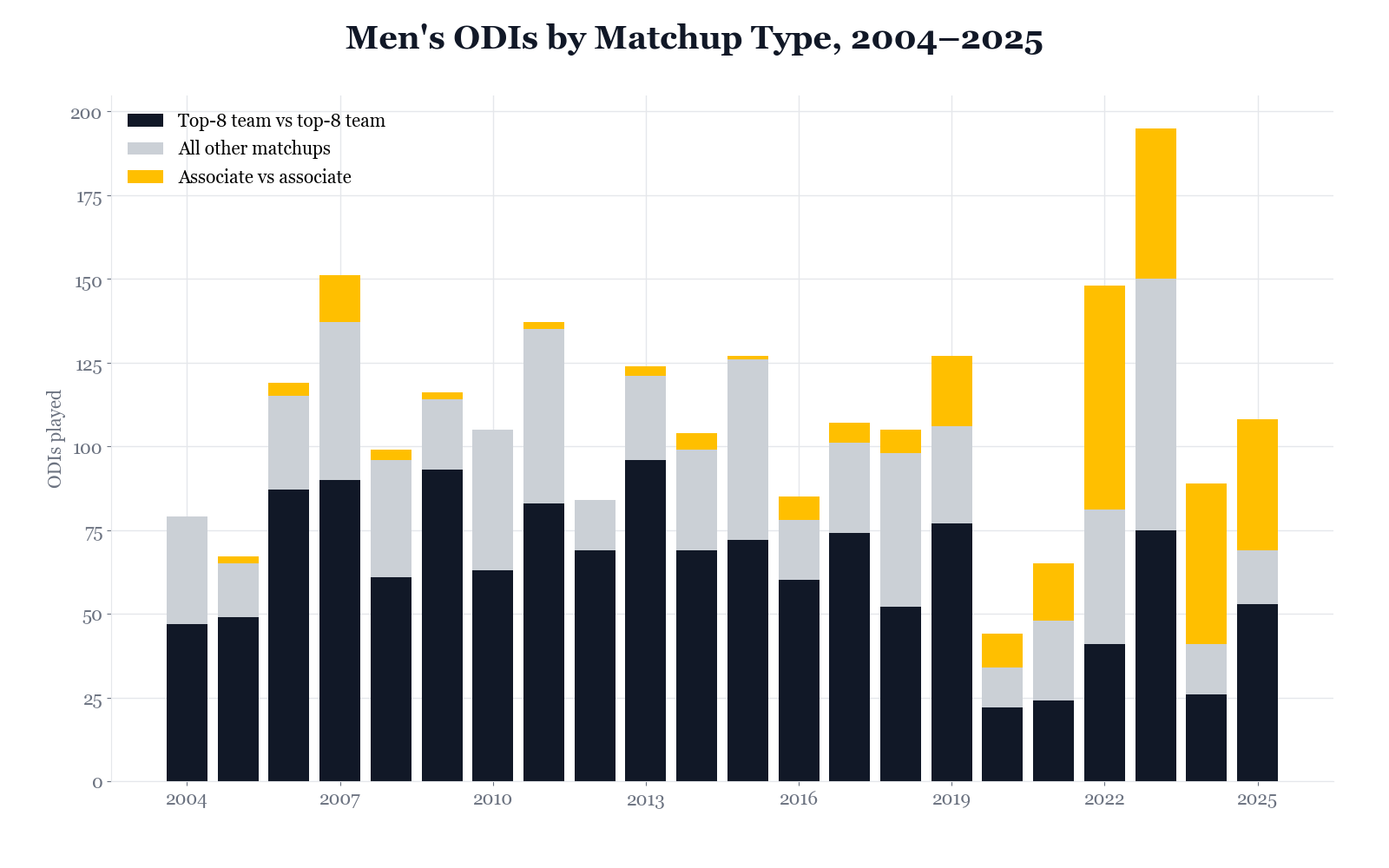
The teams with the biggest audiences and most renowned players are playing fewer ODIs, while up-and-coming teams are playing each other more frequently.
Bilateral ODI cricket between Top-8 teams, once the backbone of international cricket, has collapsed. This is the real struggle ODI cricket faces: without tangible stakes, it has little value in today’s cricket calendar.
It hasn’t helped that many players meet this very crossroads at a career level. In 2022, Ben Stokes retired from ODI cricket, at 31 years old, citing it was “unsustainable” to play all three formats. Of course, he ended up returning for the 2023 World Cup, but skipped out on over a year of bilateral ODI cricket. He didn’t see as much value in the format, prioritizing Test cricket in his case.
Quinton de Kock retired from ODIs after the 2023 World Cup, focusing on T20 cricket (a retirement he recently reversed). Steve Smith retired from ODIs after leading Australia to the semi-finals of the 2025 Champions Trophy, with his focus set on Test cricket and representing Australia’s T20I side in the Olympic Games in 2028. When players are pushed to make a choice, they are willing to first sacrifice bilateral ODI cricket.
The Boards, too, have openly favoured franchise league development over bilateral ODI cricket. In January 2023, Cricket South Africa pulled out of a 3-match ODI series against Australia to allow their players to compete in the inaugural SA20, risking automatic qualification to the 2023 World Cup.
We rarely see long, hard-fought ODI series anymore. India's upcoming ODI series in New Zealand will be their first bilateral ODI series with at least 5 games, since 2019. They played 5 such series in 2011 alone.
The Super League Experiment
The ICC tried to fix this by adding context to each bilateral series, following a model similar to that of the World Test Championship. Leading up to the 2023 World Cup, bilateral series were tied to qualification, as teams gained points with each ODI win, as part of the Super League. It didn’t quite generate the excitement intended, though, with no visible drama, and stakes that fans found too abstract. Unlike the World Test Championship, with only a 2-year cycle and a sought-after trophy, the Super League was largely a failure.
The silver lining was the opportunity it gave Associate nations. Due to the Super League, the Netherlands got to host England, Pakistan, and the West Indies, as well as tour New Zealand and South Africa, for ODIs. They demonstrated the rewards of their exposure in qualifying for the 2023 World Cup by defeating the West Indies, and upsetting South Africa and Bangladesh during the main tournament.
The 2027 Problem
The future of ODI cricket doesn’t look very promising either. Since its announcement, the 2027 World Cup format has garnered lots of criticism. The proposed '14-team World Cup' is no more than a label, as Teams 12, 13, and 14, play a 'Super Series' to determine who actually goes on to the main 12-team World Cup. That is followed by a Group Stage where the top 3 teams in each group, along with the best 4th-placed team, proceed to a second Super-7 stage. The format seems catered exclusively to a few big teams playing each other more than once, which critics have called an unashamed cash grab.
Associate teams and players have openly expressed their displeasure with the format. Scott Edwards, captain of the Netherlands at the time, claimed that despite plans to grow the game globally, decisions like this from the ICC make it harder for Associate nations to compete and improve against the best in the world, and that they need more opportunities on the global stage, not less.
Gerhard Erasmus, Namibia’s captain, stated that this is just another item in the long history of cricket limiting its opportunities for Associate teams.
Where can ODI cricket realistically go from here?
Where Can ODI Cricket Go?
It’s not quite the end of the road for 50-over cricket, and there is still time — and plenty of ways — to save it, should the world of cricket pour its efforts into doing so.
1. Revive a Tiered 'Super League 2.0'
There has been plenty of speculation over whether Test cricket should adopt a tiered system, with promotion and relegation for the Test championship. I believe that very model could bolster ODI cricket as well.
We have seen that the relegation model does work to raise stakes for teams; the West Indies failed to qualify for the 2023 World Cup after being forced to play the Qualifiers, and that made way for a rising Netherlands side to make a name for themselves.
The proposed system would combine the existing ‘World Cup League 2’ format with a ‘League 1’ tier that features all Full-Member nations as well. Stricter auto-qualification and relegation should be in place, so only the top 4 ranked teams, for example, can auto-qualify, while the remaining teams must play the Qualifiers, and the bottom 2-4 teams from League 1 are relegated to League 2. Likewise, top teams from League 2 would be promoted to League 1. The Champions Trophy can then be restricted to only feature teams in League 1, while the World Cup has spots up for grabs from Qualifiers including League 2 teams.
Leagues don’t necessarily need to restrict teams by what opposition they play, but can instead weight teams’ success by the opposition they face; wins against teams in League 1 are worth more than wins against teams in League 2, rewarding great performances and upsets from lower-ranked teams.
2. Rotating Tri-Series
Recent discourse on ODI cricket has brought about points on the tri-series, and why it died out. In mid-October alone, we saw two fantastic tri-series: one between Afghanistan, Zimbabwe, and Bangladesh, where Afghanistan went on an undefeated run to secure the trophy, and another between Pakistan, England, and Sri Lanka, which saw two back-to-back record-breaking chases that went down to the wire.
Tri-series bring more weight to each series, with a little more challenge and a lot more to play for than a traditional bilateral series. A tri-series format with rotating teams would allow for even more exposure, featuring at least one top team and at least one Associate nation. This gives the opportunity for Associate nations to compete against the best, and even script history on a good day.
This tri-series format can also slot directly into a Tiered Super League system for World Cup and Champions Trophy qualification.
3. Pooled Rights & Board Incentives
Part of the death of the tri-series came down to finances, with bilaterals being the more viable option for boards, more often than not. Ultimately, much of saving ODI cricket comes down to restructuring the financial model of international cricket, which is where the ICC must step in.
For tri-series, pooling rights is a plausible and beneficial reality, where broadcast rights can be sold centrally, with revenue split between the participating nations. Host venues would still maintain ticket and ground revenues, while each board would earn more than what a traditional bilateral would earn them.
If goodwill remains the decider for Associates facing the top teams, the Associates will unfortunately see very few fixtures, just like they presently do. The boards of the top teams need a reason to play Associate teams, and that must come from the ICC.
The ICC could, for instance, tie a part of each team’s revenue distribution to the fixtures they schedule against Associate nations, incentivizing big boards to face lower-ranked teams to earn their fair share. Allowing Associate teams to host games would also expand the game into newer markets. India's recent tour of Ireland, albeit limited to T20Is, was a resounding success for Irish cricket, both financially and competitively.
Calendar Windows
Arguably the most discussed topic regarding the future of cricket has been the possibility of fixed windows for franchise leagues, Test cricket, and ODI cricket. This would be crucial for ODI cricket to secure a fixed and viable place in the cricket calendar, ensuring that ODI cricket isn’t sidelined or left as last-minute preparation for major tournaments.
Where ODI Cricket Ends Up
The way we are currently progressing, there will only be less and less space for ODI cricket, shrinking from bilaterals, to warm-up games, to just World Cups and major tournaments, to no ODI World Cups at all, in an extreme case.
ODI cricket still has a place in our hearts, and deserves respect after producing years of unforgettable encounters, memories and, most importantly, the World Cup, which changed the trajectory of international cricket forever.
If we, as cricket fans, wish for a globally competitive sport while still maintaining its tradition, we need to preserve and expand all formats of the game, which cannot be accomplished unless we bring meaning to every game, and open doors for more teams to participate.
ODI cricket deserves better than a slow fade out, and I truly hope September’s Super Sunday wasn’t the last we will ever see.