
October 7, 2026
South Africa vs Australia: Series Preview
Eight years after sandpaper-gate, and a year after South Africa beat them in the World Test Championship final at Lord's, Australia are back on South African shores for revenge. With Rabada and Ngidi injured, Steve Smith's return, Labuschagne under fire and talk of a dust bowl in Durban, we break down both sides and predict each team's XI for the first test at Kingsmead.
Introduction
In June 2025, South Africa did what no South African side had done in 27 years: they won an ICC trophy. They did it at Lord's, against Australia, chasing down the target to win the World Test Championship final by 5 wickets, off the back of Aiden Markram's heroic 136 in the chase.
Australia are back for revenge, and return to South African shores for the first time since that series in 2018. The series that saw sandpaper-gate, arguably cricket’s most infamous cheating scandal. The series that AB de Villiers himself famously dubbed “one to be remembered”, just one test in, before scoring a match-winning hundred in the very next test. A series full of fiery battles, on and off the field.
8 years on, and the cricketing world is brimming with excitement for two titans to take each other on. How do the two teams stack up?

Unfinished Business
Since South Africa’s readmission to Test Cricket, they’ve formed one of the greatest cricketing rivalries with Australia. The two sides have met in 49 tests since 1993, of which Australia lead head-to-heads with 25 wins to South Africa’s 16, along with 8 draws. These records hide two contrasting periods, though.
When Australia’s golden generation took over, they won 15 of the first 24 tests against the Proteas, only losing 4. Australia beat South Africa 3-0 at home in 2001-02, before winning 2-1 on the return tour of South Africa, a series that saw South Africa’s worst ever test defeat, by an innings and 360 runs.
Everything changed in 2008, though. Graeme Smith had begun establishing a formidable South African side, and their tour to Australia that year flipped the script. AB de Villiers mentioned on “Keepin’ it Cricket”, how winning against that Australian team almost felt unthinkable, especially in their own backyard. However, it just took one day of belief, for AB himself to join skipper Graeme in chasing down a massive target of 414 at the WACA. The Proteas won the series 2-1, and then went on to become one of the strongest test sides in history.
They’ve managed 12 test wins in 25 games against Australia since 2008, with 10 losses.
Interestingly, though, South Africa has only won one home test series against Australia since readmission. That came in 2018, during a series overshadowed by controversy and sandpaper.
South Africa
We start with the current World Test Champions South Africa. The last time the Proteas played test cricket, they beat India in India 2-0 for the first time in 25 years. That was 11 months ago, though. Yes, the World Test Champions haven’t played a test in nearly a year.
Even more surprisingly, South Africa hasn’t played a 3-test series since December 2022, on their tour to Australia. Since 2023, South Africa has exclusively played in 2-match test series, and their rustiness going into a longer series may prove costly if this series goes down to the wire.
Rabada & Ngidi: Hamstring Woes
The Proteas’ biggest strength over the last few years is their pace attack. They have been blessed with an arsenal of pacers, led by Kagiso Rabada and supported by Marco Jansen, Lungi Ngidi, Dane Paterson, and a host of others, despite regular injuries to their personnel.
Since the start of the 2023 World Test Championship Cycle, South Africa’s bowlers have had the 4th-best bowling strike rate against the top 3 batters of the opposition, with only Australia having a better bowling average against top 3 opposition batters in this time.
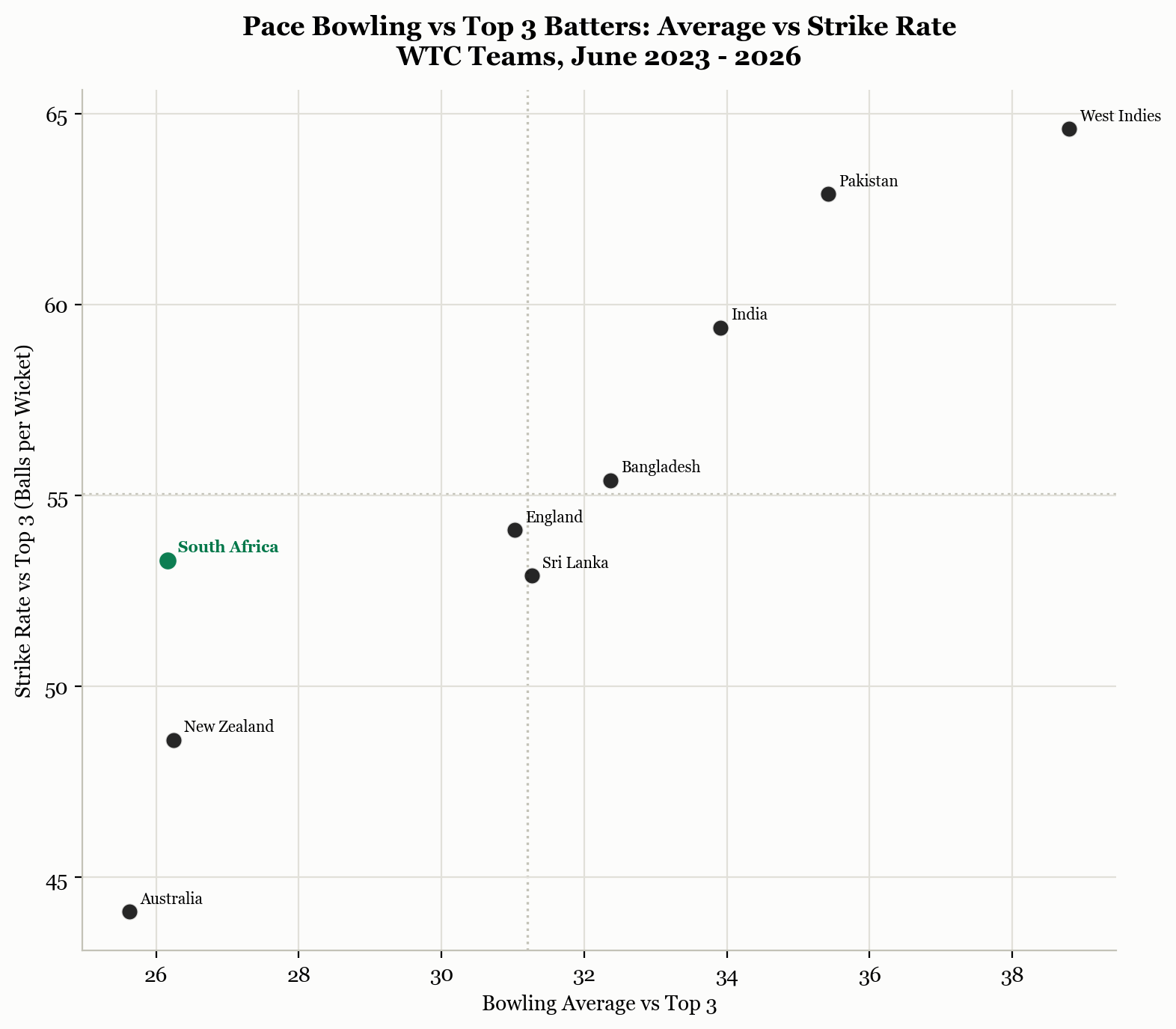
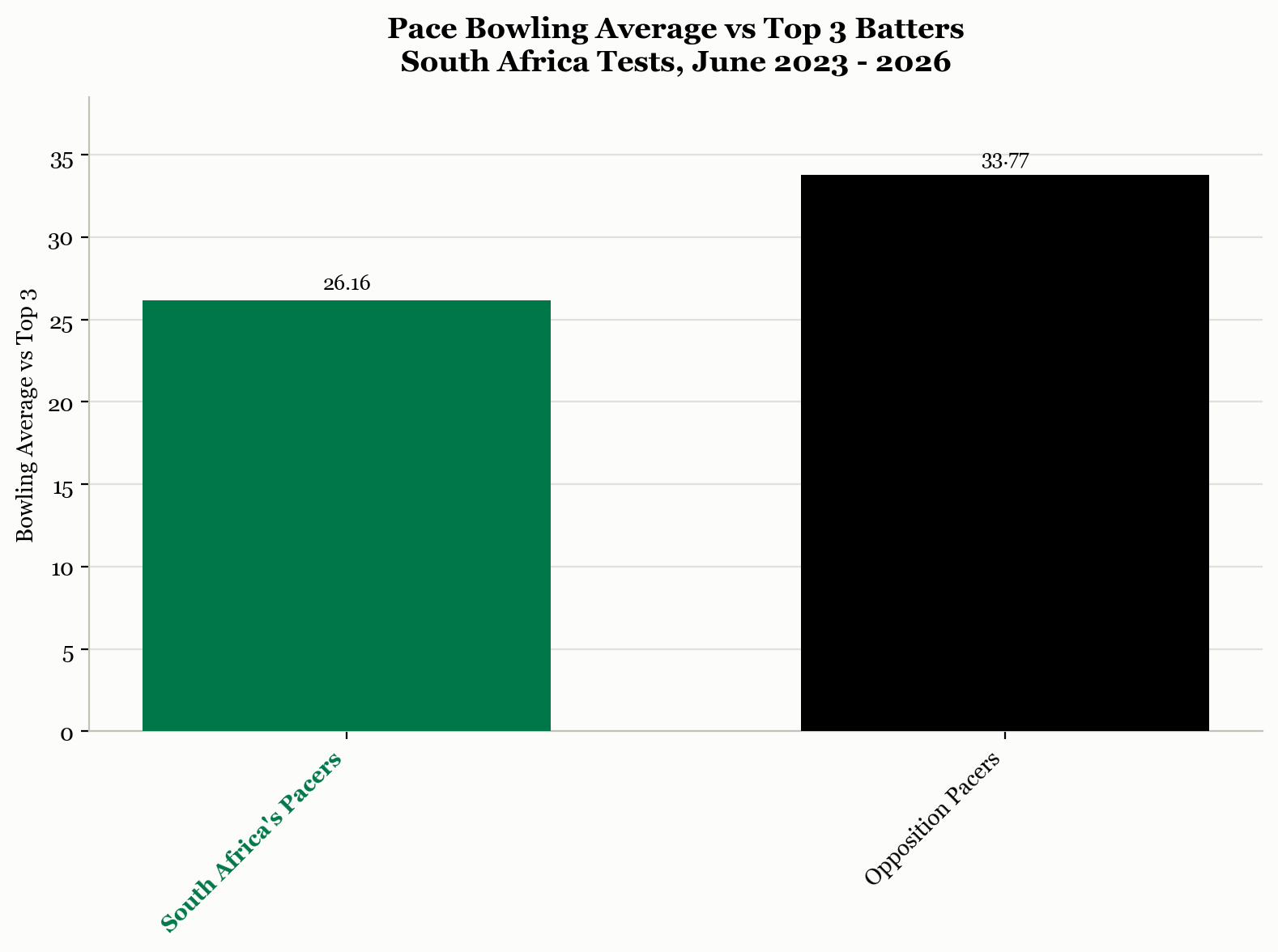
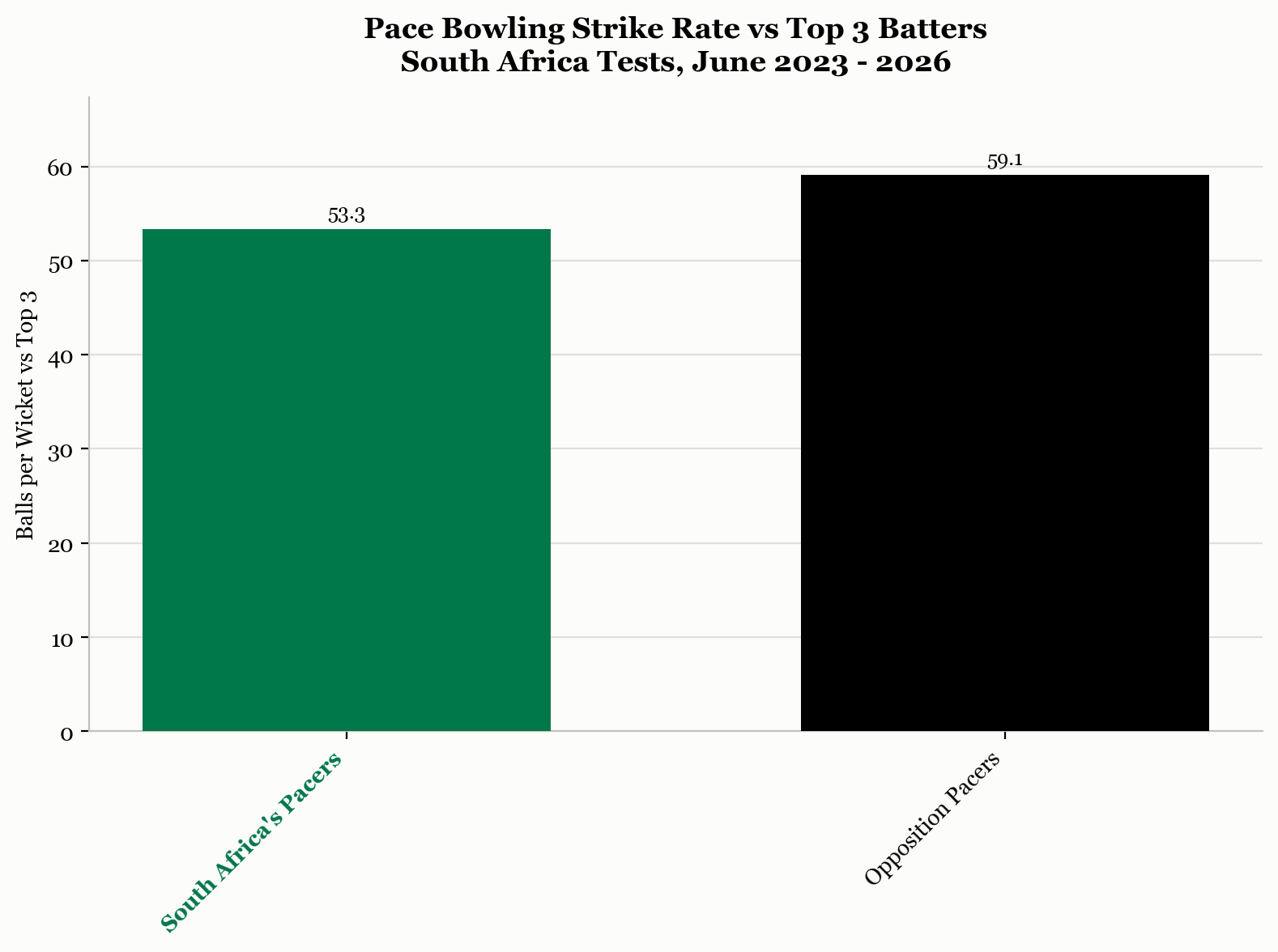
South Africa’s pacers average 26 against the top 3 opposition batters in their games since June 2023, while their opponents’ pacers average over 33 against the Proteas’ top 3.
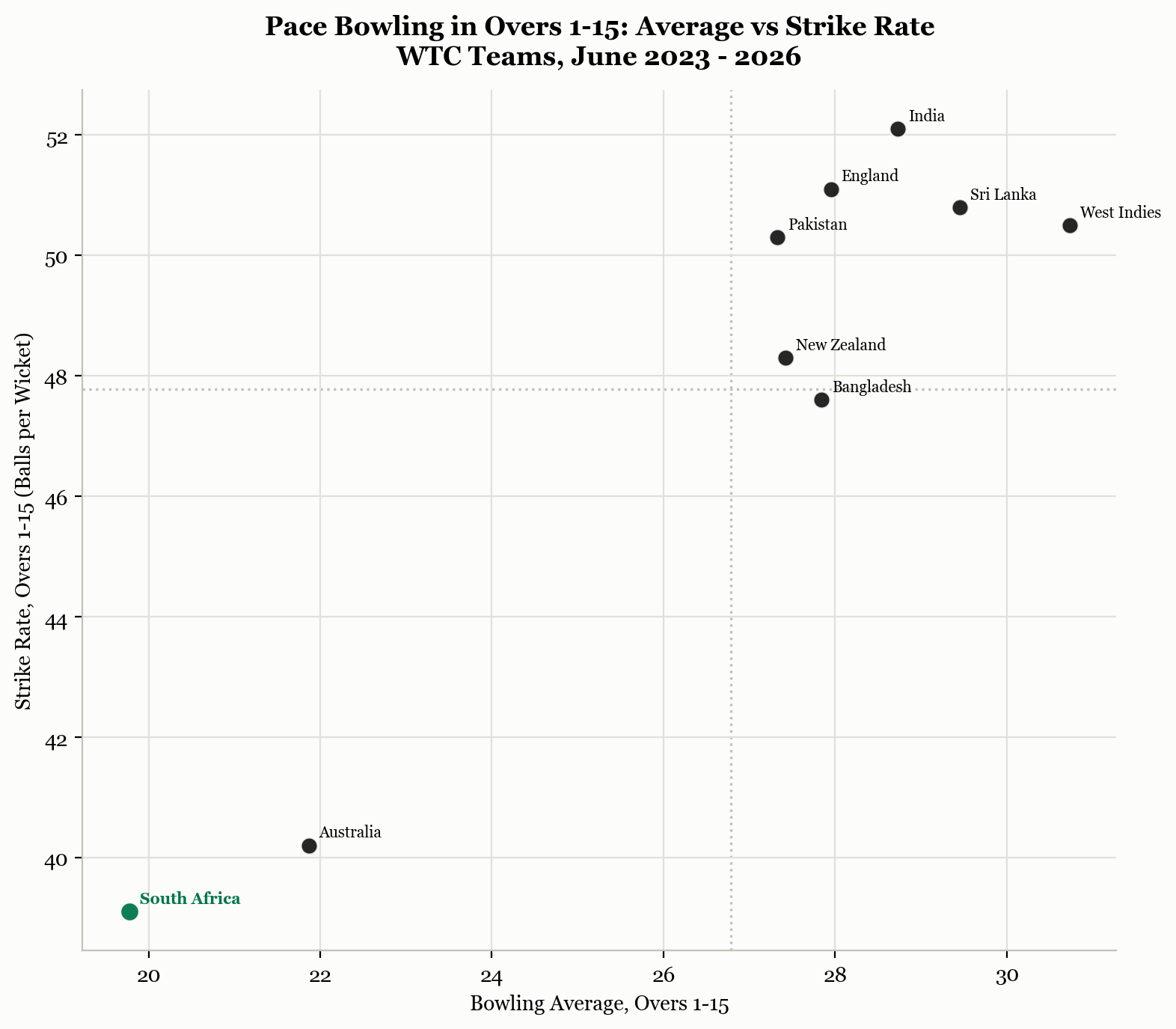
When it comes to new-ball exploits, South Africa tops the charts at having the lowest bowling average and lowest bowling strike rate in the first 15 overs of an innings. Of course, their home advantage typically supports swing and seam bowling early in an innings, assisting their skillful pace battery, but this is impressive nonetheless.
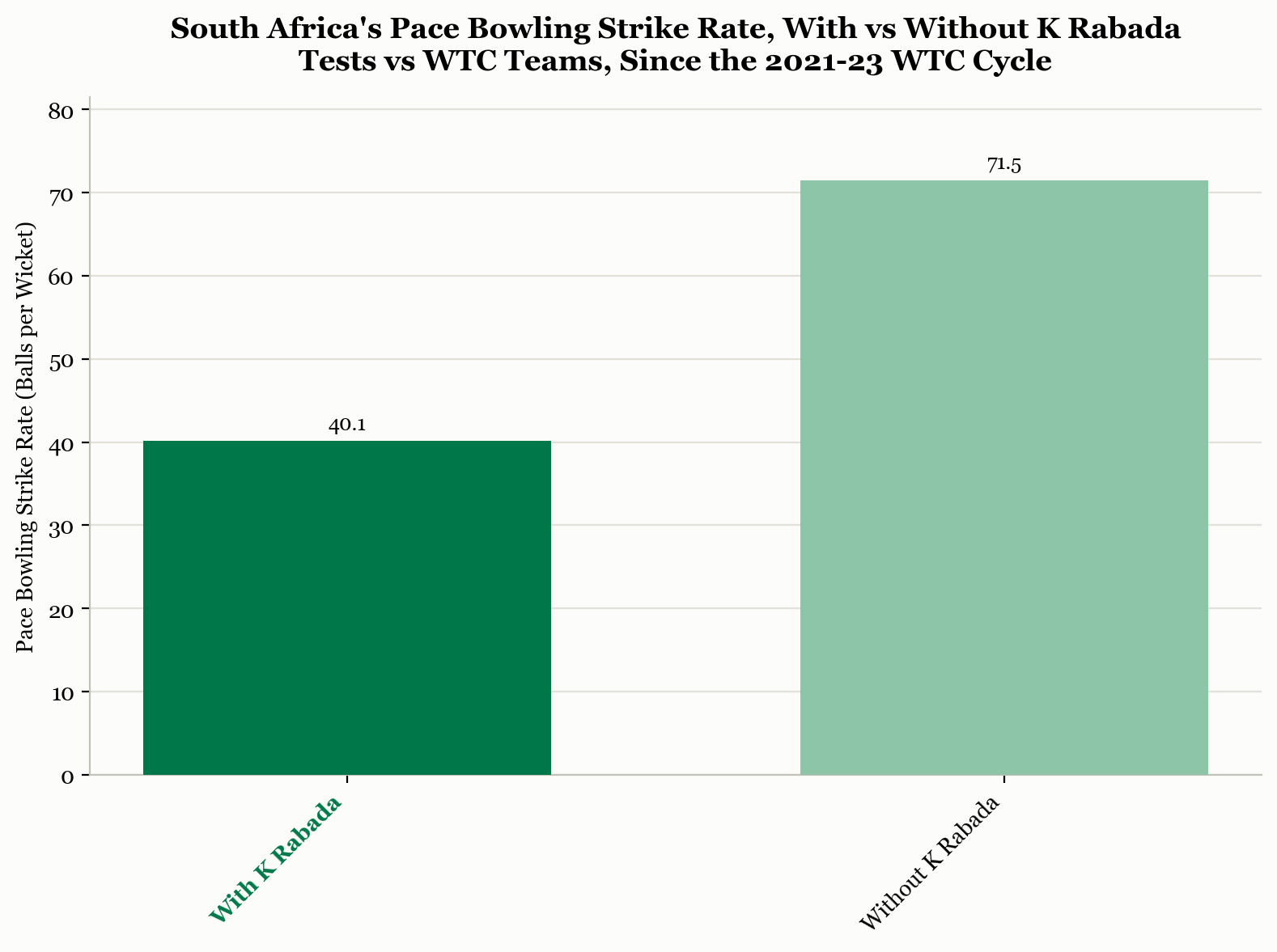
Despite their strengths, though, the Proteas’ pace attack has often been reliant on their leader Kagiso Rabada. Since the start of the 2021-2023 World Test Championship Cycle, South Africa’s pacers average just over 23 when Rabada plays. That average jumps to a sub-par 34 when Rabada isn’t playing.
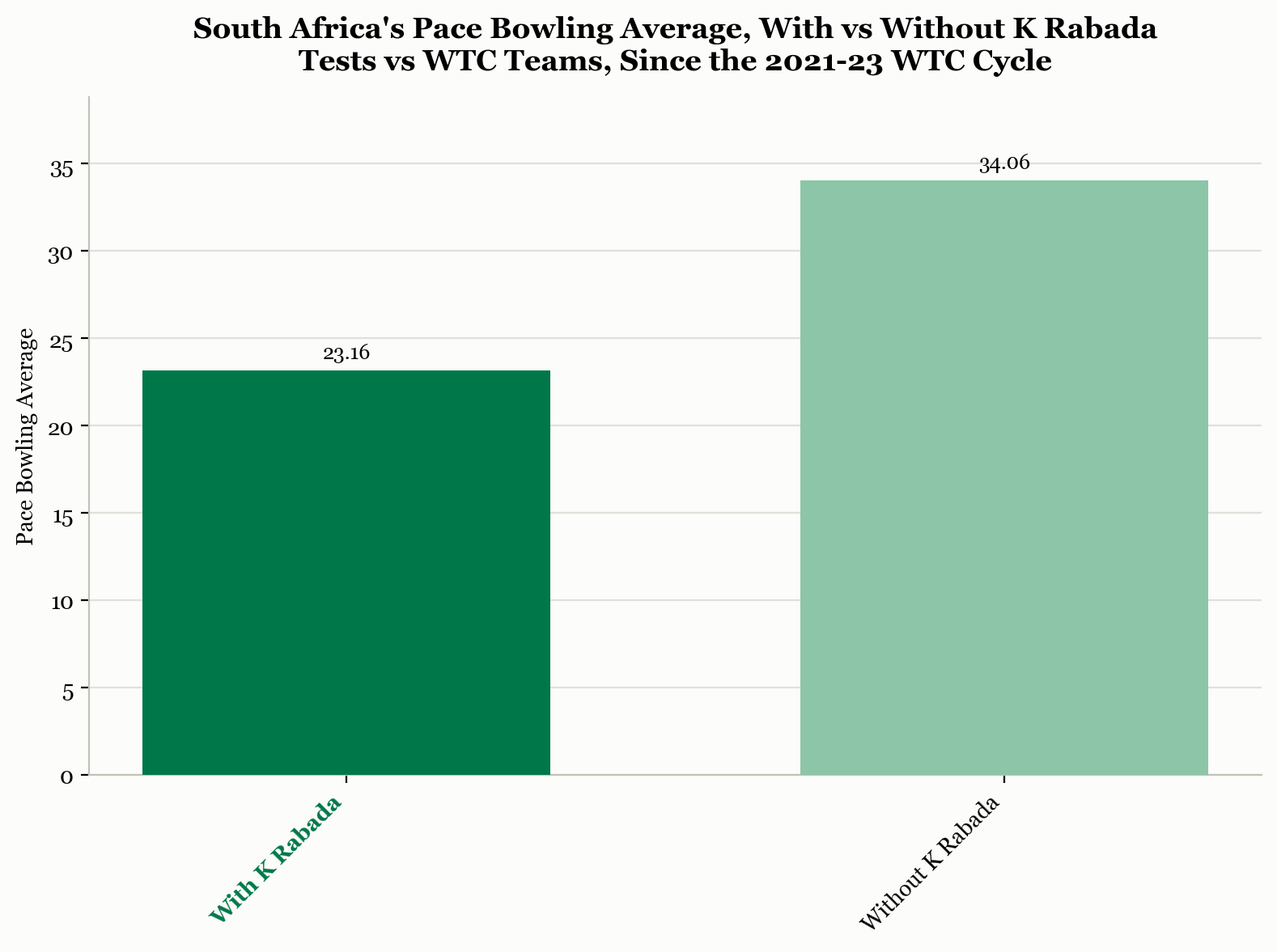
Their drop-off in strike rate is even more concerning, as the South African pacers take an average of 31 more balls to pick a wicket when Rabada isn’t playing, compared to when he is. That’s an additional 5 overs per wicket taken by pacers.
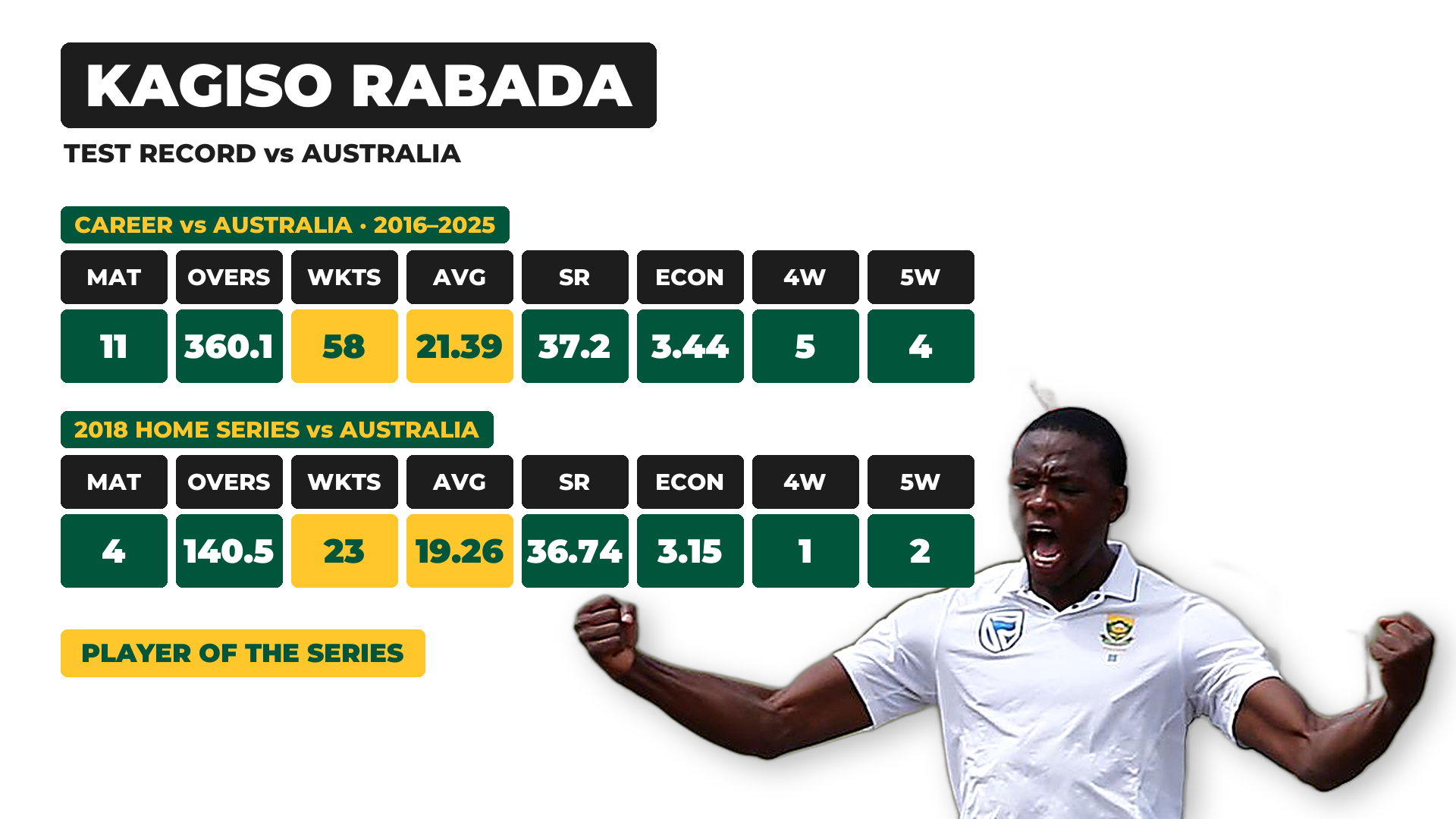
Rabada also turns up the heat when against Australia. At just 22 years old, Rabada was named player of the series in the 4-match home series against the Aussies in 2018, where he picked 23 wickets with 2 fifers and a 4-fer, averaging just 19.
KG’s overall record against Australia is among the best. He’s got 58 wickets in 11 games against them, at an average of just 21.39. Even as recently as the World Test Championship final last year, Rabada picked 9 scalps and brought the Proteas back into the game.
All eyes will be on whether or not Rabada can make a comeback. Although Shukri Conrad and the coaching staff are confident in his recovery, batting coach Ashwell Prince confirmed they will take a call “as late as possible” on Rabada’s inclusion.
Lungi Ngidi is also out with a hamstring injury, leaving another hole in South Africa’s bowling attack. Ngidi was crucial in the second innings of the World Test Championship final, where he picked up 3-38 in his 13 overs, including the wickets of Steve Smith and Beau Webster.
These injuries, though, mean South Africa can explore their squad depth and enjoy the surplus of pacers they have.
Dane Paterson's Comeback
Firstly, this means Dane Paterson will likely be a shoo-in for the first test, making a comeback to the Proteas test side. Paterson being dropped ahead of the World Test Championship Final in 2025 raised eyebrows, particularly given how important he was in getting South Africa to the final in the first place.
Paterson only has 7 tests under his belt, of which 5 came in the previous WTC cycle. However, he was key against Sri Lanka and Pakistan, where he picked 16 wickets at just 16.06 from 3 games. He helped book South Africa’s spot in the final, and played the perfect foil to Rabada and Jansen, and gave more flexibility so the Proteas could afford to play 7 pure batters.
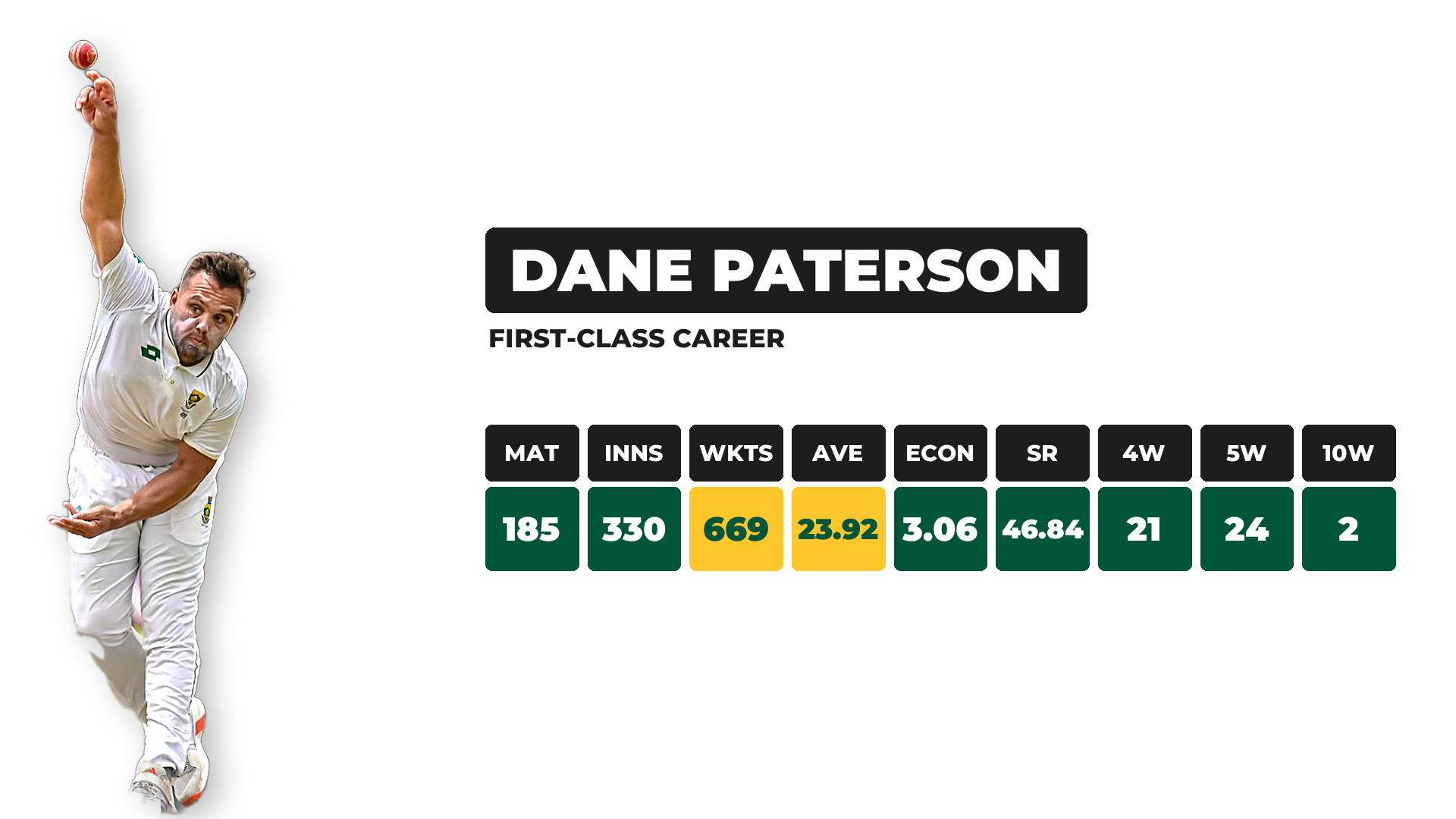
Paterson’s greatest asset is his experience. He’s played 185 first-class games, nearly double that of even Kagiso Rabada, with 669 wickets averaging 23.92 and striking every 46.8 balls in this time. If both Rabada and Ngidi are to miss the first game, Paterson’s experience will be all the more valuable.
Nortje's Return
Anrich Nortje's last Test was on 28 February 2023, against the West Indies. He’s been off the field most of the time since then, but even when he’s been injury free, he reserves himself for white-ball cricket. Now, Nortje is 32, and in contention for his first Test in over three and a half years.
His test record so far is solid, with 70 wickets from 19 tests at 26.71. However, it is his express pace that South Africa cannot easily replicate. He’s the one bowler who can clock at 150Ks and genuinely beat the Aussies for speed. There will be skepticism over his match fitness, though, given he hasn’t had to bowl in test cricket in years.
Conrad clearly trusts his preparation, though, citing that Nortje had been in touch with him, and that “He’s as pedantic and as professional as they come.”
Corbin Bosch?
Corbin Bosch deserves a mention here, because he has been unbelievable in the few opportunities he’s had. In his 4-test career so far, he averages 61 with the bat, and 18.9 with the ball. Of course, two of those tests came against Zimbabwe, who aren’t even in the World Test Championship. Still, every time he has represented the Proteas, it seems he levels his game up, across formats.
Bosch didn’t seem at his best in the ODI series, though. He was wayward with his lines in the first two ODIs against Australia, and got picked apart by Travis Head and Mitchell Marsh. He also hasn’t been tested enough in the test arena to claim a guaranteed spot in the XI, especially given South Africa have a similar all-rounder with Marco Jansen in the side. If South Africa don’t opt for two spinners at Durban, Bosch should find a place at 8 over Mulder.
Dust Bowl in Durban?
There has been much talk about spin playing a role in the first test at Durban, especially after Maharaj and Fortuin’s exploits against the Aussie side in the ODI series last week.
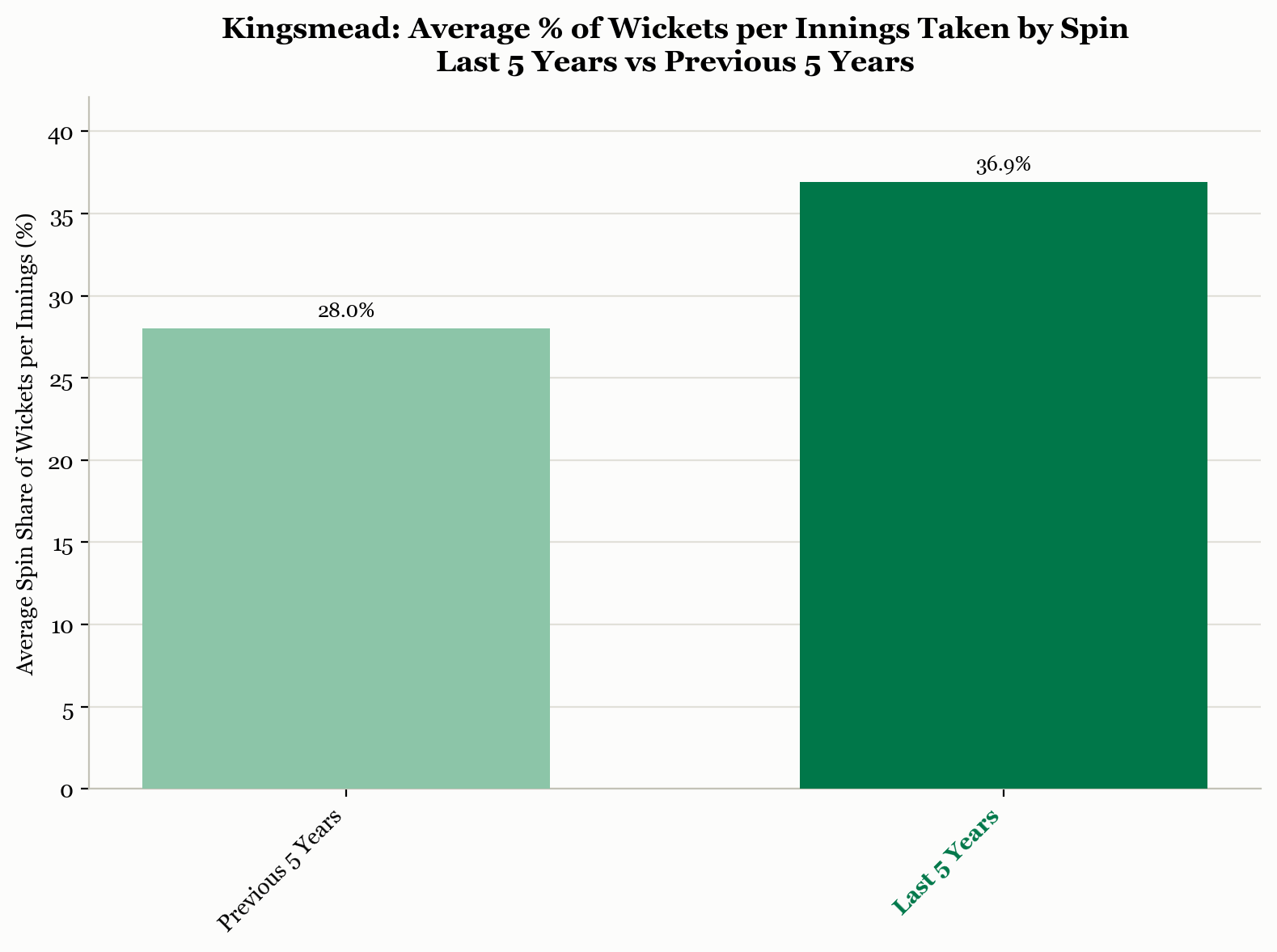
Durban is humid, and Kingsmead’s surface has favored spinners as of late. Spinners have picked nearly 37% of test wickets per innings in the last 5 years in Durban, up from 28% in the 5 years before that.
In 2022, it was Maharaj and Harmer who picked all 10 wickets in the fourth innings against Bangladesh to bundle them out for just 53.
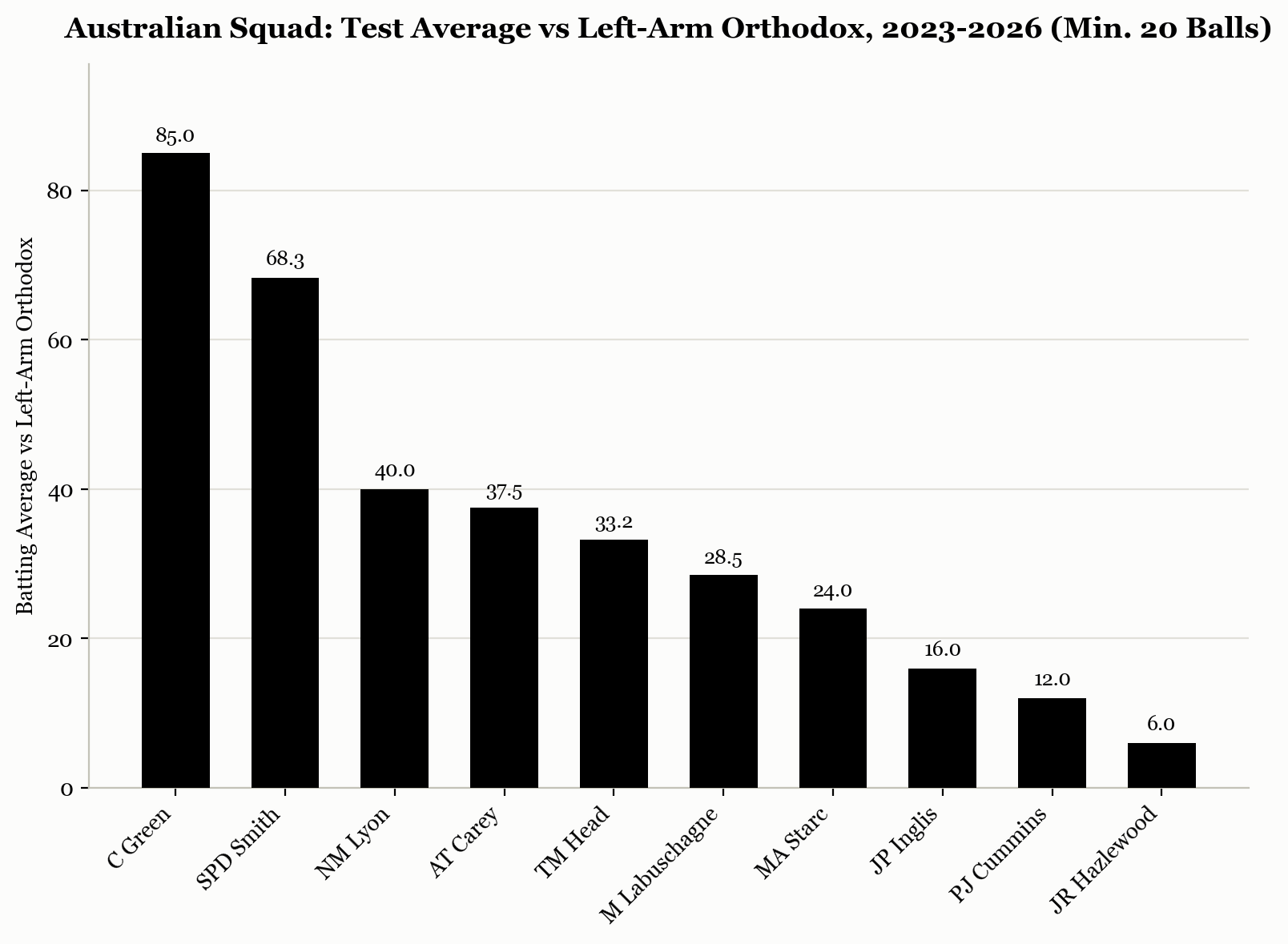
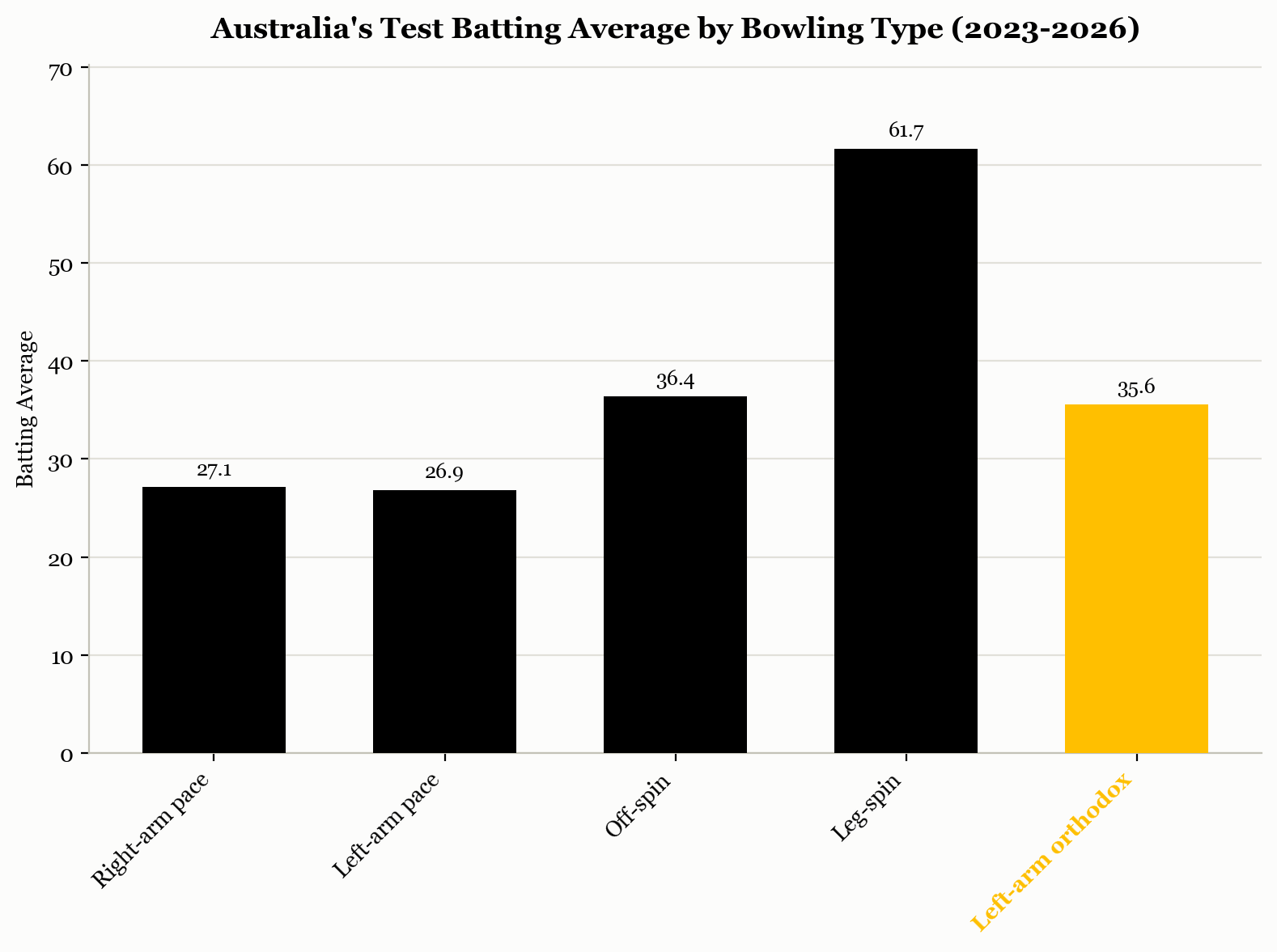
Australia’s own batting hasn’t looked confident against spin, particularly left-arm orthodox. Steve Smith and Cameron Green are the only Aussie batters who have dominant records against left-armers. It should be a concern when Nathan Lyon has the 3rd best average against left-arm spin in your squad. The Proteas may look to employ both Maharaj and Muthusamy’s left-arm spin against the Australian lineup.
Harmer and Muthusamy have a combined test experience of just 5 tests in South Africa, though. Both are almost exclusively picked for tours to the subcontinent, and rarely feature at home. Muthusamy has also never taken a test wicket at home, in the 8 overs that he has bowled. So unless the Proteas expect some serious turn, they will likely both be left out.
Muthusamy makes a stronger claim for inclusion given his form with the bat of late. In his last 5 test innings, he made 283 runs from the lower order, averaging a staggering 94.3, with 1 century and 2 fifties. He played a crucial role in South Africa’s historic triumph in India last year, and their test win against Pakistan in Pakistan.
Should Muthusamy feature in the first test in Durban?
Proteas' Batting
South Africa’s batting lineup is relatively settled. Markram and Rickelton are set to open, especially given de Zorzi’s recent injury.
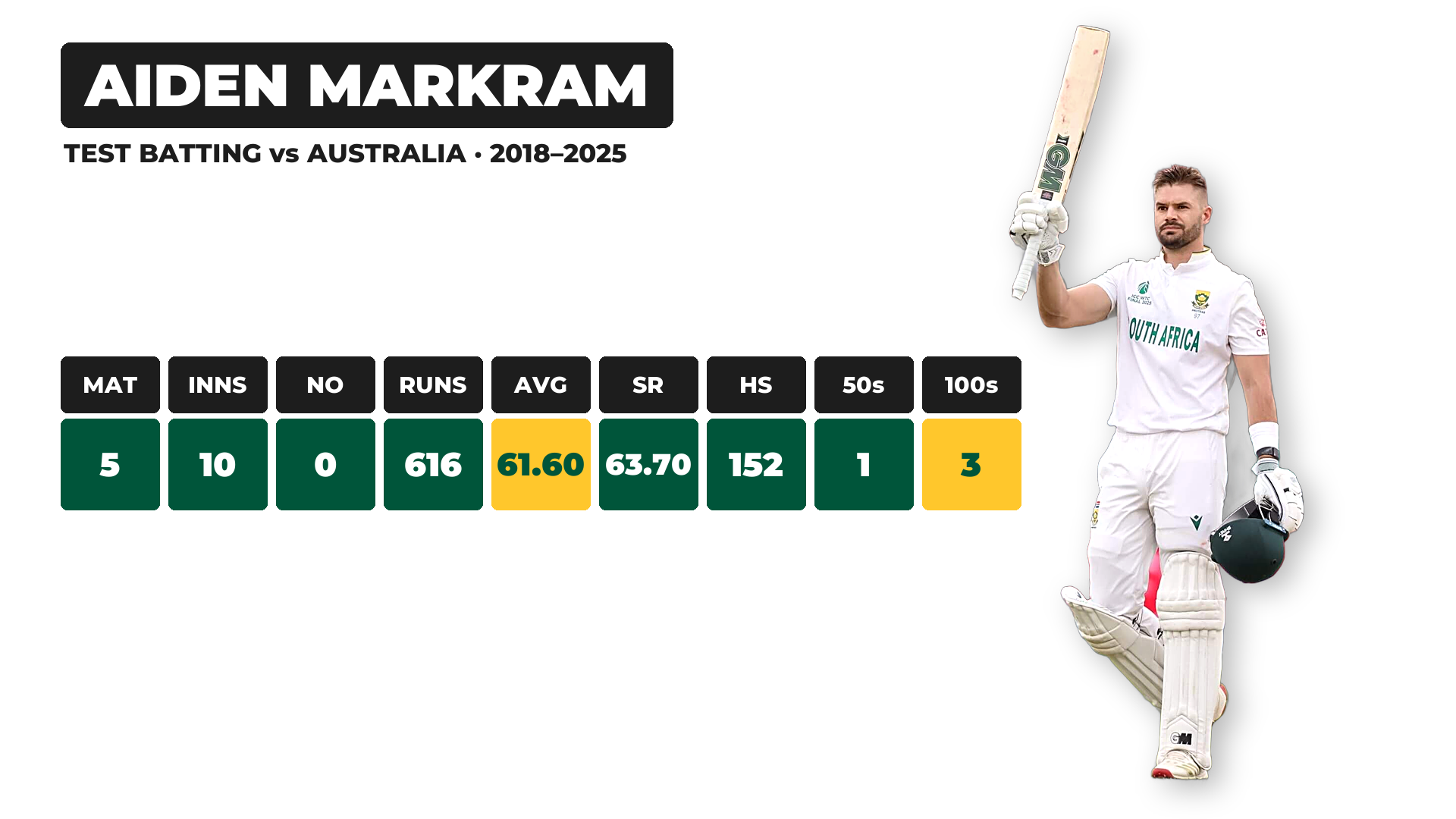
Markram would be confident heading into the first test, given his last encounter produced an all-time knock for the Proteas. He has a strong record against the Aussies, averaging 61 from 10 innings, with 3 hundreds and a 50.
Rickelton on the other hand didn’t fare too well in the World Test Championship Final against the same opposition, but would be looking to change that this series.
Temba Bavuma should walk in at number 4, unsurprisingly. The skipper has been South Africa’s most reliable bat since 2023, averaging over 53 with 3 hundreds in this time. Bavuma has led from the front, and been the glue to this batting lineup during his career purple patch.
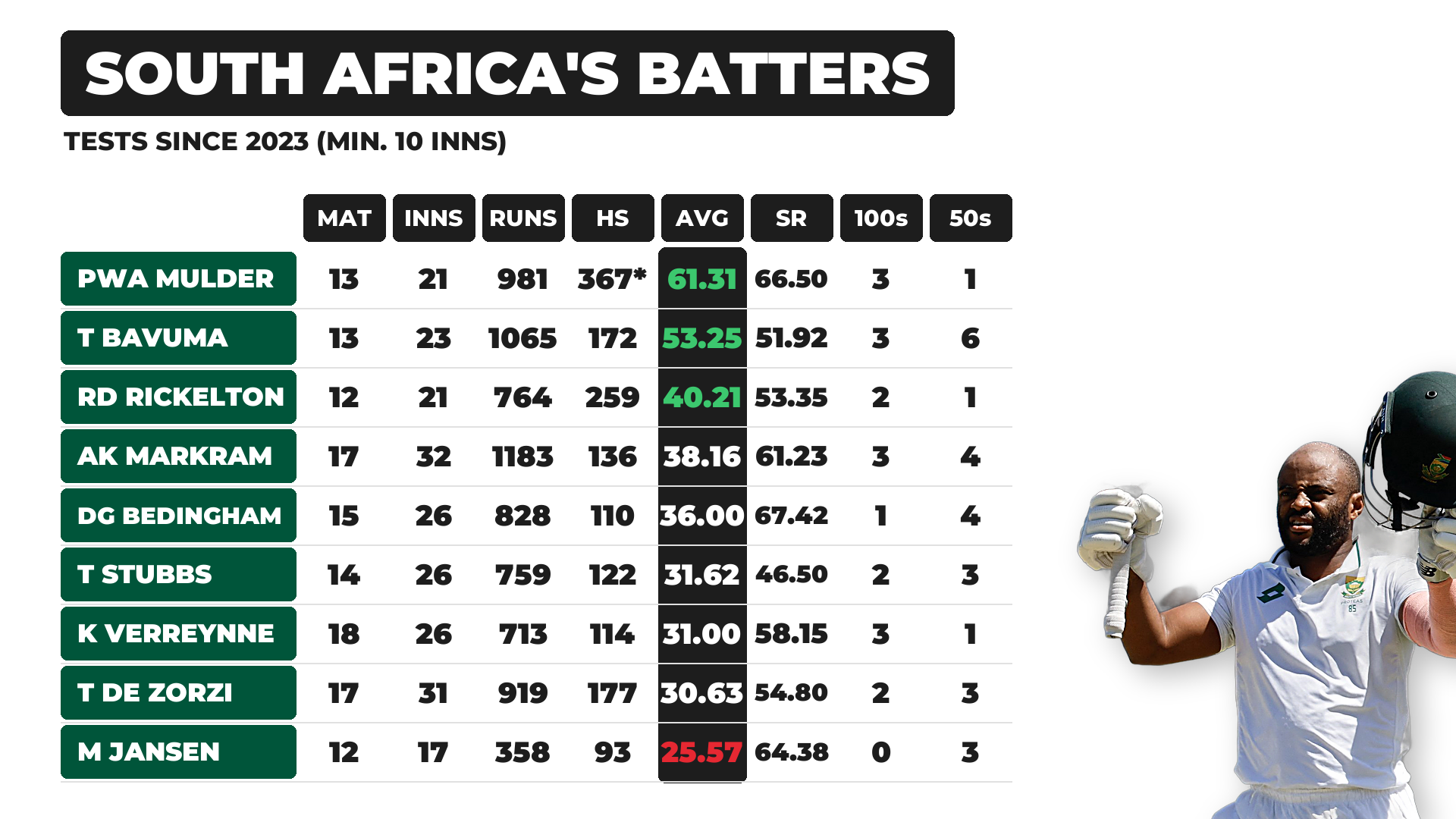
Kyle Verreynne also slots into the lineup, given he’s been South Africa’s chosen wicket keeper over the last few years. Although his record with the bat isn’t stellar, he has changed games when he gets in, with his 3 hundreds since 2023.
However, two batters in particular will draw many eyes this series:
Marques Ackerman & David Bedingham
Ackerman is the only uncapped player in South Africa’s squad, and is almost certainly set to debut in the first test at his home ground in Durban. He comes off the back of a massive 256 against Bangladesh A just last month, his highest first-class score, before registering yet another ton for the Dolphins in South Africa’s domestic circuit. Ackerman has been making a name for himself in first-class cricket over the last few years, and has finally earned a place in the squad, and will certainly look to make the most of it.
He will likely slot in at 3, unless Bavuma is willing to move up to accommodate Ackerman at 4.
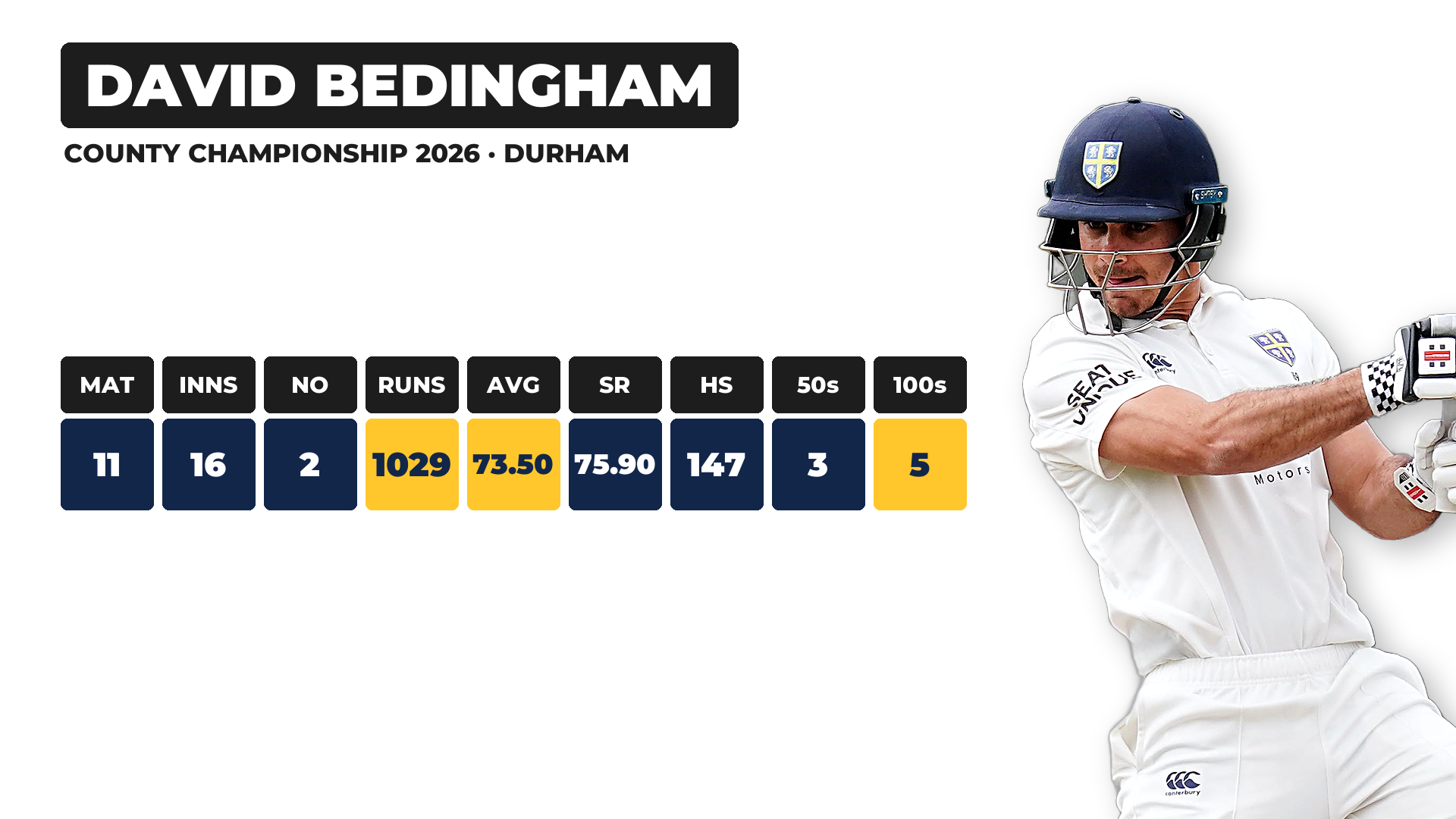
The other batter in incredible form is David Bedingham, off the back of a fantastic season with Durham at the County Championship. Bedingham helped Durham return to Division One next season, with a stellar 1,029-run season in 16 innings, to go with 5 centuries. Bedingham only averages 36 in his test career so far, but averaged 46 in his 4 tests last year, and has only been in better form since. He would look to assert himself in this massive series.
This does mean neither Mulder nor Stubbs would find a place in the top 4, and likely for the better.
Mulder may average 61.31 in the last 3 years, but much of that comes from his brilliant 367* against Zimbabwe in Bulawayo. Excluding that innings, Mulder’s average drops to 38.4, with 614 runs from 20 innings. Perhaps fit for a lower-order batter, but not at the top.
Stubbs’ numbers also haven’t lived up to his promise so far. The youngster averages 31.6 in his 14 tests, not enough to claim a spot in the top 6 of this side, unless he is to pip Verreynne as the keeper.
SA XI
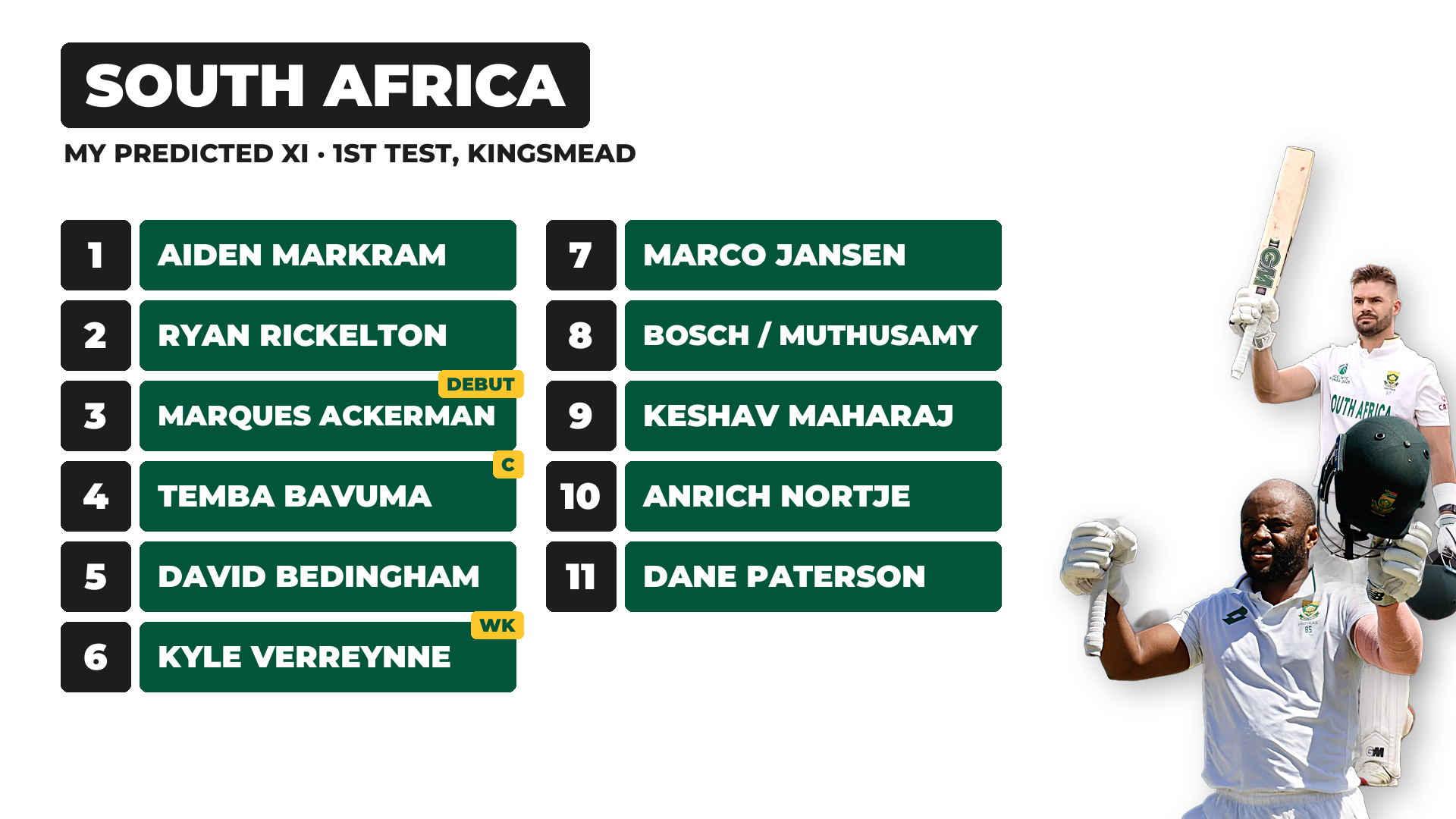
My predicted XI for the First Test:
Australia
The Cartel's Blaze of Glory
Ahead of this tour, Josh Hazlewood spoke on how “this group still has a few boxes to tick”, referring to winning away in South Africa, India, and England. Yes, all three of those tours are scheduled within the next 12 months for Australia, as well as a 4-test series at home against New Zealand. Hazlewood is 35 now, but his hunger hasn’t subsided.
Nathan Lyon is no different. The 38-year-old has repeatedly shut down any talks of retirement, claiming that it won’t cross his mind until this Australian team has won everywhere in the world.
Those are the expectations of this attack, and rightfully so. We have witnessed one of the greatest, most lethal, and most complete bowling attacks of the 21st century, and probably of test cricket history.
Of the 6 players in the current squad who featured in Australia’s 2018 tour of South Africa, four of them form the cartel: Starc, Hazlewood, Cummins, and Lyon.
There is no overstating their success as a team over the last decade, especially in the last 5 years. They have been so dominant that even Scott Boland, who has the best average for a pace bowler since 2021, at just 18, can’t break into the playing XI when all four are fit.
However, they are just about the only strength of this team, and the batting is where the concerns begin. Australia may be hoping for the cartel to bail them out of another batting crisis, a trend that has become all too familiar for Australia over the last two years.
Steve Smith is Back
The biggest talking point of the summer thus far has been that the man himself, Steve Smith, is back to South African shores for the first time since 2018 for a red-ball tour. Yes, the last time Smith played a test here was the very test that saw sandpaper-gate.
Smith has since turned his career around, and established himself as one of the all-time greats in test cricket, but he has frequently cited the trauma he got post-2018.
The South African fans will certainly take every opportunity to remind the Aussies, particularly Smith, of what happened last time around in Cape Town, and it will take a lot out of Smith to tune out the noise.
Interestingly, South Africa is also the side Smith averages 2nd-lowest against, at 44.42. In his 11 innings in South Africa, he averages just over 41, with 1 ton. Of course, Smith hasn’t even played a test there since 2018, and he’s evolved ten-fold as a player since then.
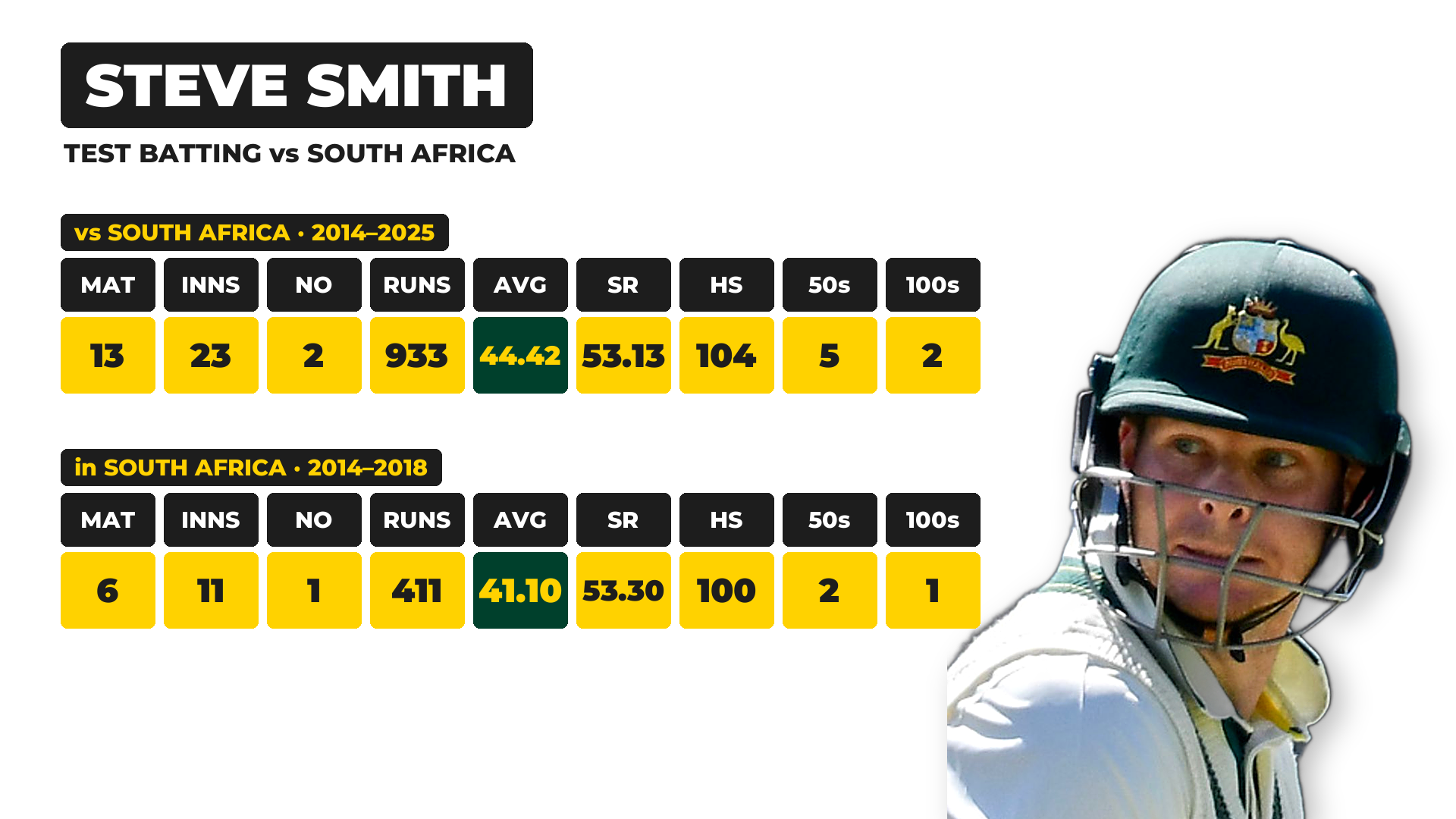
Since 2023, Steve Smith has been Australia’s best batter averaging 44. Travis Head is the only other batter with an average above 41, and the pair have more combined hundreds (at 11) than the rest of Australia’s batters combined.
The success of Steve Smith with the bat may be the crux of the series, and will likely dictate Australia’s returns from the three tests.
Marnus Labuschagne?
The most glaring problem with Australia’s lineup has been Marnus Labuschagne. Once the world’s number 1 test batter, he averages 29.62 since 2023, which includes 62 test innings. That is not fit for any Number 3 batter, let alone one of Marnus’ caliber.
Labuschagne’s form dipped so far that he was dropped after last year’s WTC final, before he earned a spot back after a few hundreds in the Shield. However, his form remained poor in the test arena in last year’s Ashes, with only two 50+ scores, averaging 28.77.
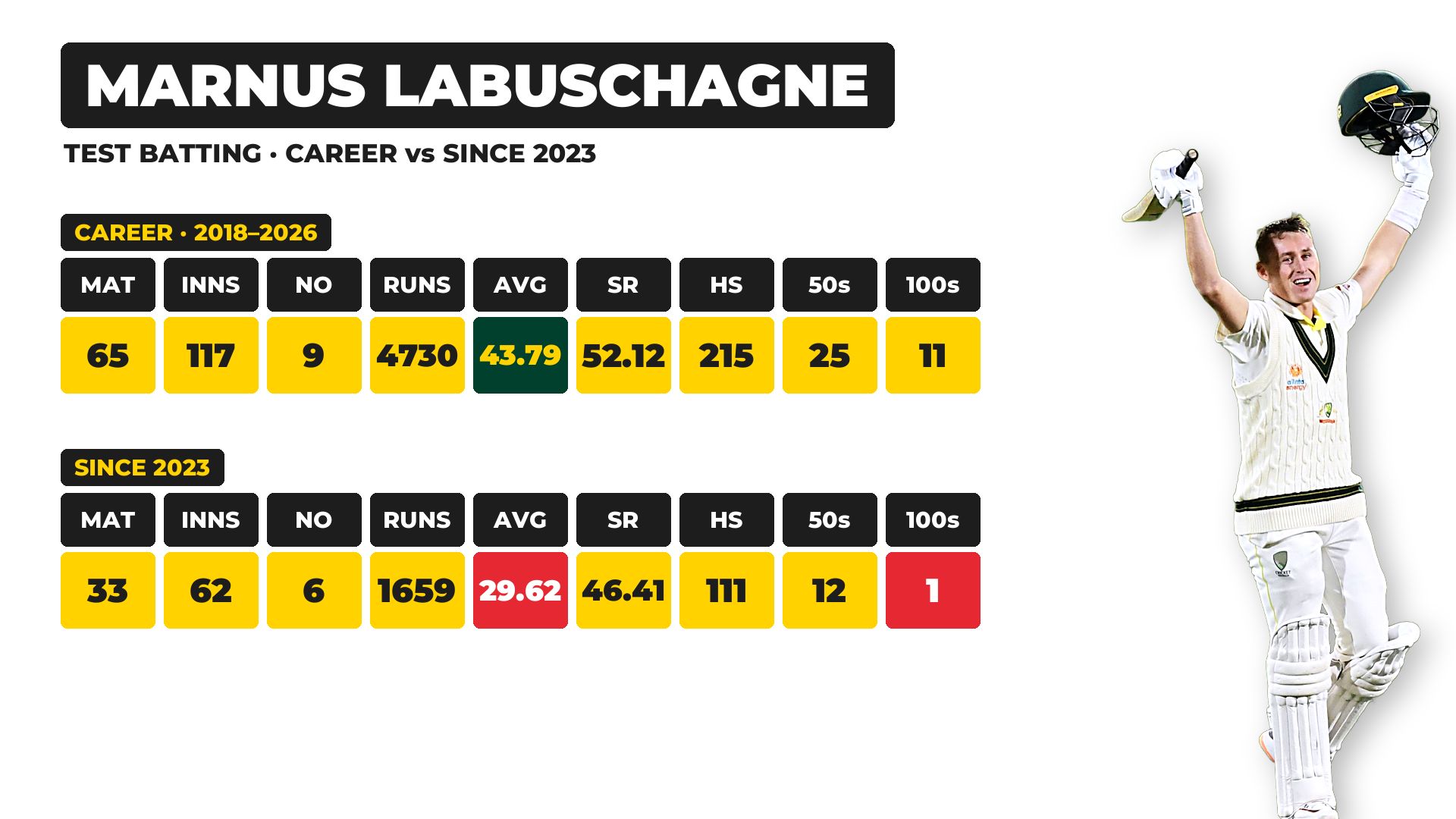
The selectors have received a lot of flak for sticking with Marnus despite a long string of low scores, but the batter made a big statement last week. He piled on an unbeaten 111 against the CSA Invitation XI in a two-day warm-up game.
If there was ever a series for Labuschagne’s fortunes to change, it would be this one. The cricketing world waits to see what Marnus brings back to his place of birth: South Africa.
A Top Order in Flux
Besides Marnus, Australia have struggled to find a reliable top order, particularly with their opening combination. Since David Warner retired, Australia have tried Steve Smith, Sam Konstas, Nathan McSweeney, and Jake Weatherald as Usman Khawaja’s partner up top, but none of them stuck. It wasn’t until Travis Head’s game-changing century at Perth in last year’s Ashes, that Australia finally found an opener to stick with. But by the end of the series, Khawaja himself retired, leaving another opening slot vacant.
Interestingly, the selectors haven’t given any of the new openers a long rope. McSweeney, Konstas, and Weatherald only got a total of 14 tests between them, of which 10 came from either the Ashes or the Border-Gavaskar Trophy, arguably the two hardest series in Australia’s calendar.
Matt Renshaw was most recently roped in to replace Weatherald, but he didn’t fare too well in the 2nd Test against Bangladesh, with just 8 runs in his only innings. That was also his first test for Australia in three years.
Heading into this series, Australia have given a surprise call-up to Nic Maddinson, which has caused outrage in the nation. Matthew Hayden slammed the decision as disrespectful to Australia’s first-class system.
Fans and critics have also called for Travis Head to return to the middle order, where he’s most dangerous. While he has found success as an opener so far, with 3 centuries from 15 innings averaging 51, his last four innings as an opener have been 29, 22, 17, and 22 respectively, of which 3 innings came against an inexperienced Bangladesh side at home.
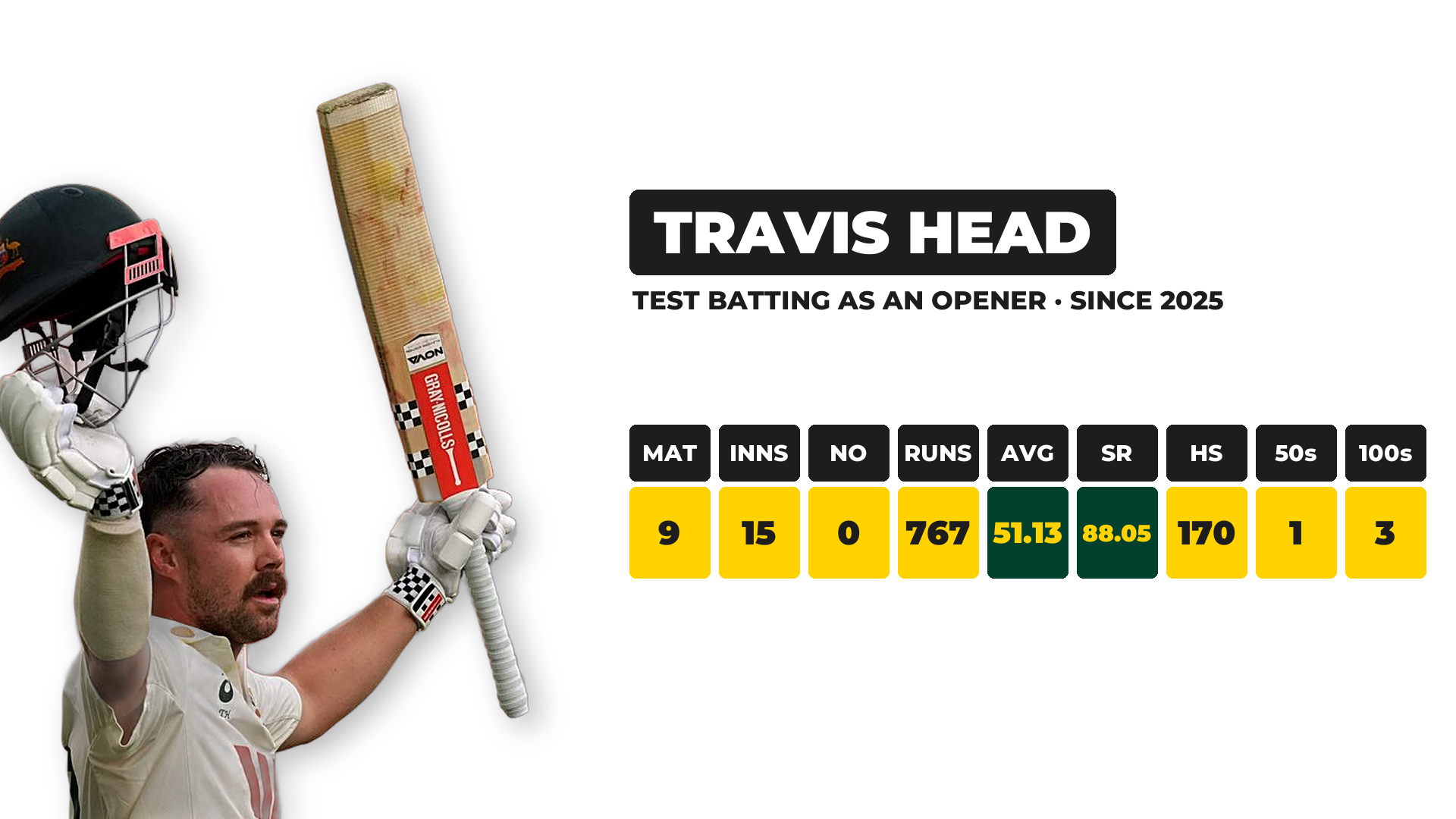
Will Australia move Head back to the middle-order, and push a fresh Nic Maddinson up top?
The Left-Arm Spin Problem
Australia have developed a weakness against left-arm spin that has recently become more prominent. In the first ODI itself, Australia lost 6 wickets to spin, of which Maharaj picked 4 at a stunning economy rate of just 2.1 in his 9.2 overs.
Only Steve Smith and Cam Green have comforting records against left-arm orthodox in test cricket. Nathan Lyon averages more against left-armers than Alex Carey, Travis Head, and Beau Webster, surely the biggest indicator of concern. You would think the left-handers in Australia’s lineup share a favorable matchup against left-arm orthodox, but the stats say otherwise, and Australia won’t be too keen on facing Maharaj in Durban.
Injuries Galore
Australia are also battling their fair share of injuries. Josh Inglis was ruled out during the ODI series, unfortunate considering he looked in good nick with the white ball. That brought in Sam Harper, who also just scored a ton for Australia A against India A. More recently, though, came Cameron Green’s side strain injury, ruling him out of the first test. Although Green hasn’t bowled much as of late in test cricket, his exclusion does harm the balance of the Aussie side.
Green seemed to finally find his rhythm as a batter in test cricket again, against Bangladesh last month. He finished as the series’ leading run-scorer, with a crucial hundred in the first test in tough conditions, albeit in a losing cause. His newfound confidence with the bat would have been instrumental in this series, amidst a lineup that otherwise lacks it.
Where does this leave Australia with their batting order? They are missing two reliable options for middle-lower order batters. Should they back young Cooper Connolly? The 23-year-old has only played 1 test, but has been in fantastic touch throughout the year. His timing looked exquisite in the ODI series against the Proteas, and he looks promising should he convert his form into red-ball cricket.
However, question marks still loom over much of this Australian batting lineup, and they will need to be answered soon.
AUS XI
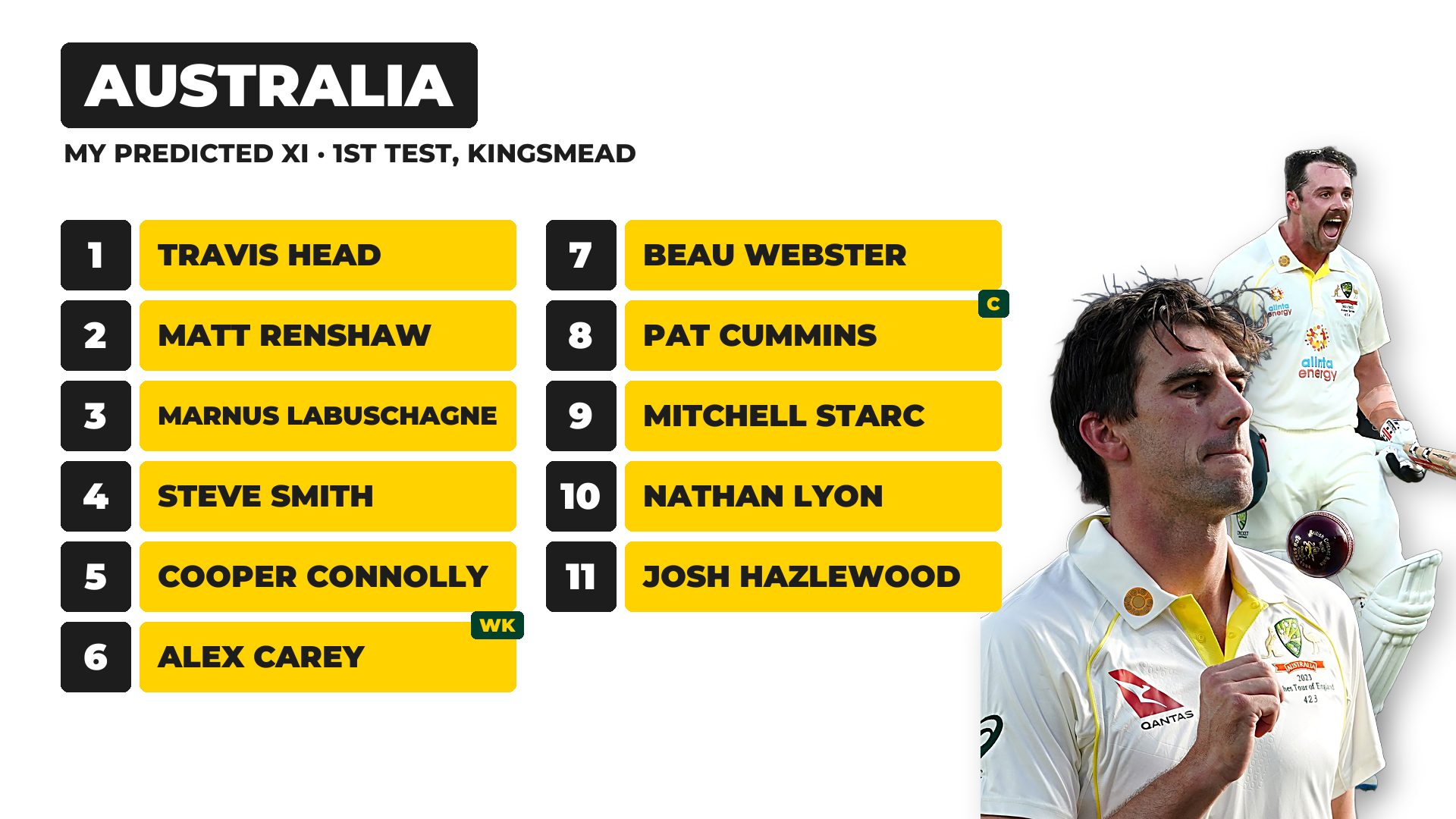
My predicted XI for Australia heading into the first test:
WTC Context
This series carries enormous weight in the 2025-27 World Test Championship cycle. South Africa sit second on the table with a points percentage of 75.00, but that comes from just 4 tests. With only 14 tests in their entire cycle, compared to Australia's 22, every result swings South Africa's standing far more. Each test is worth over 7% of the Proteas' total available points, compared to roughly 4.5% for Australia.
A 3-0 series win would send South Africa to the top of the table on 85.7%, while a 3-0 loss would drop them to 42.9%, leaving them with plenty of ground to make up.
The good news for the Proteas is that their run-in is kind. After Australia, they host Bangladesh for 2 tests and England for 3, before finishing with a 2-test tour of Sri Lanka. That's 8 of their last 10 tests at home. Recent finalists have qualified with points percentages between the high 60s and 70, so South Africa will want to win roughly 6 of their remaining 10 tests to stay on course for a second straight final. Winning this series would put them well on their way.
Australia lead the 2025-27 World Test Championship table, with 8 wins from 10 tests and a points percentage of 80.00. They have the longest road of any side in this cycle, though, with 12 tests still to play: 3 here in South Africa, a 4-test home series against New Zealand, and a 5-test tour of India to finish.
That run-in is far tougher than South Africa's. New Zealand currently sit third on 72.22%, and although India may have dropped off recently, they are always a challenge at home. Australia will want to bank as many points as they can before they land in India.
A 3-0 win here would push Australia to 84.6%, and leave them needing just 4 wins from their final 9 tests to finish around 68%. A 3-0 loss would drop them to 61.5%, putting real pressure on the New Zealand series and leaving them chasing results in India. To stay comfortably in the race for a third straight final, Australia will want roughly 6 wins from their last 12 tests.
Will the Proteas assert their dominance at home? Will the Aussies crush any reminder of their last visit here? We are in for a blockbuster series this month...